Global cloud spending keeps climbing, and so does the share of it that goes to waste. According to the Flexera 2026 State of the Cloud Report, wasted cloud spend has ticked back up to 29 percent after five straight years of improvement. This was driven largely by the cost complexity of AI workloads and the sprawl of new IaaS and PaaS services. Large enterprises now routinely spend more than five million dollars a month on public cloud. 63% of organizations have a dedicated FinOps team in place to keep that spend under control.
That is exactly why FinOps certification has become one of the fastest growing credentials in tech. A certification proves you understand cloud economics, cost allocation, and what ties finance, engineering, and business teams together. It also signals to employers that you can walk into a cost review and actually move the needle. This guide walks through every certification the FinOps Foundation currently offers. You’ll learn what changed in the catalog this year, and how to choose the right path for where you are in your career.
What is a FinOps certification
A FinOps certification validates a professional’s ability to manage and optimize cloud spending using the FinOps Framework maintained by the FinOps Foundation. It confirms hands-on knowledge of cloud pricing models, cost allocation and tagging, the Inform. It goes towards the Optimize, and Operate lifecycle, and teache , how to apply those same disciplines to AI and GPU spend. Most certifications combine self paced or instructor led training with a proctored or online exam. Successful candidates receive a digital badge through Credly that they can add to LinkedIn and their resume.
The FinOps Foundation is the body behind nearly every recognized certification in the field. It maintains the FinOps Framework, runs the FinOps X conference each year, hosts an active Slack community practitioners can join for free. It also publishes the annual State of FinOps report that most of the industry cites when talking about cloud waste and maturity trends. Its certification catalog is not static. It gets rebuilt every year to track where cloud spend is actually going. This is why the 2026 lineup looks noticeably different from the one certified professionals studied in 2024.
What changed in the FinOps certification catalog for 2026
If you looked at FinOps certifications two years ago and assumed the landscape was settled, it is worth a fresh look. Three changes matter most this year.
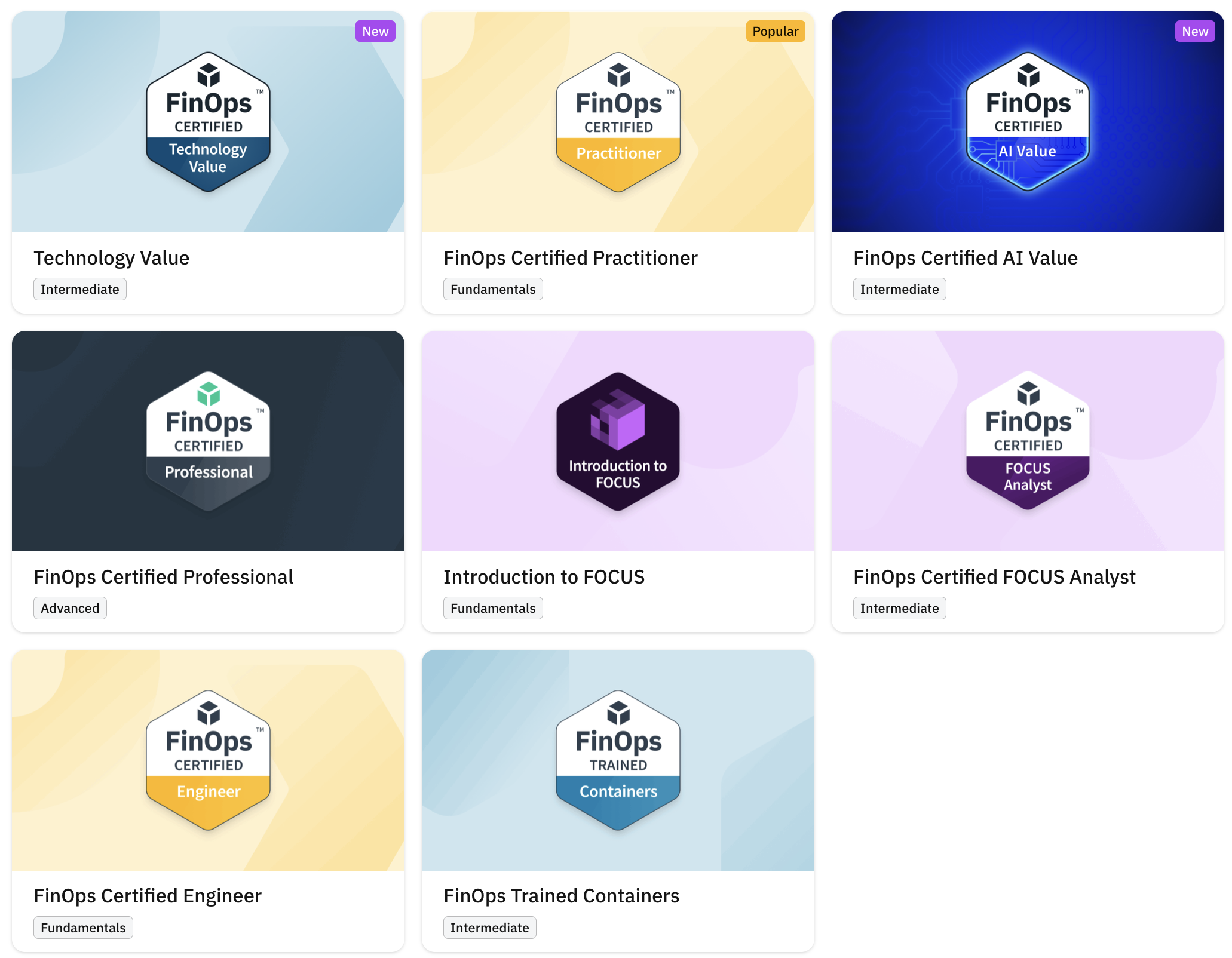
First, the Foundation launched FinOps Certified: AI Value, the industry’s first formal certification dedicated to managing AI related cloud spend. The exam went live in March 2026, right around FinOps X in San Diego, and it exists because the numbers demanded it. The FinOps Foundation’s own State of FinOps 2026 survey found that 98 percent of organizations now manage AI spend, up from just 31 percent two years earlier. AI cost management is now the single most in demand skill FinOps teams are trying to build. If you work anywhere near GPU compute, model training, inference billing, or LLM API consumption, this is the credential to watch.
Second, the old FOCUS Analyst track has effectively been absorbed into a broader, more ambitious certification. It’s now called FinOps Certified: Technology Value. Instead of only covering the FOCUS data specification, it now spans FinOps Scopes across public cloud, SaaS, data center, and data cloud platforms. This reflectins the Foundation’s own shift in language from cloud cost management to full technology value management. The standalone FOCUS Analyst exam still exists for practitioners who only need the data specification piece. However Technology Value is now the umbrella credential for anyone managing a mixed technology estate.
Third, pricing across the catalog has been simplified. Most core certifications, including FinOps Certified Practitioner, AI Value, Technology Value, and Professional, are now priced at 500 dollars each. There is bundle pricing that makes stacking two or three certifications meaningfully cheaper than buying them one at a time. FinOps for Containers dropped from 350 to 250 dollars. We will go through exact numbers certification by certification below.
Why DevOps and finance professionals should get FinOps certified
Cloud becomes the backbone of most technology stack, and as AI workloads add an entirely new layer of billing complexity. The ability to translate spend into business value is no longer a nice to have. A FinOps certification proves you can do that translation.
For engineers and DevOps professionals, certification is a way to move beyond writing infrastructure code and into conversations about what that infrastructure actually costs and why. For finance professionals, it closes the opposite gap. It gives you enough technical fluency in cloud billing, commitment or AI cost drivers to hold your own in a room full of engineers. The practical benefits tend to show up quickly. Certified professionals are more competitive in the job market, more likely to be pulled into cost governance decisions, and better equipped to make the case for savings initiatives that actually get funded. And with AI spend now touching almost every organization, the professionals who understand both cloud economics and AI billing models are the ones getting first pick of the newest FinOps roles.
What you actually learn in FinOps certification training
Every certification track builds on the same core pillars, then specializes from there.
Cloud cost management fundamentals cover pricing models such as pay-as-you-go, reserved capacity, CUD, and spot or preemptible instances. It goes along with the tagging and allocation techniques needed to assign cost accurately across teams, products, and business units.
The FinOps lifecycle, Inform, Optimize, and Operate, is the backbone of nearly every exam. Inform is about visibility: building dashboards, alerts, and reports that keep stakeholders aware of spend in near real time. Optimize is about action: rightsizing, automation, commitment discount strategy, and workload placement. Operate is about sustaining the practice: continuous governance, budget ownership, and policy enforcement so gains do not erode over time.
Cloud optimization techniques dig into identifying underused or orphaned resources, redundant services, and inefficiencies, then applying fixes without breaking reliability. FinOps governance covers the policies, guardrails, and accountability structures that keep spend aligned with business priorities. And collaboration and communication, often underrated, teaches practitioners how to present cost data to non technical stakeholders. Something that must be done in a way that actually drives decisions rather than being ignored in a spreadsheet.
The newer tracks extend this same structure into numerous new domains. Those include AI and multi domain technology spend, GPU and inference cost drivers, AI unit economics, SaaS contract governance etc.
Every FinOps certification available in 2026
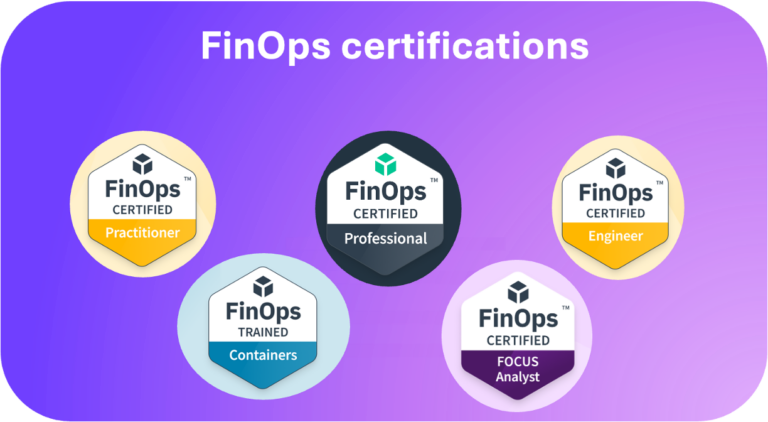
1. FinOps Certified Practitioner (FOCP)
This remains the foundation of the entire catalog and the certification most employers recognize by name. It is built for anyone touching cloud cost management day to day, including financial analysts, cloud architects and cloud engineers. Also business leaders who need a working vocabulary for cloud economics.
Level: Intermediate. Format: two self paced modules covering cloud cost fundamentals, cloud financial operations, and governance best practices. It takes roughly 16 hours to complete. Cost: 500 dollars for the self paced course plus exam. There is an exam only option available at 325 dollars for candidates who already know the material and want three attempts within a year. Validity: 24 months, with a standalone recertification exam priced at 162.50 dollars when it lapses.
2. FinOps Certified: AI Value (new for 2026)
This is the certification generating the most conversation in the FinOps community right now. It was built specifically to help practitioners understand, manage, and optimize AI related cloud spend. It launched in phases through 2025 and early 2026 so learners could start building skills before the market fully matured around AI billing models.
The curriculum runs across four progressive stages. An introductory module on identifying AI related costs and aligning them with the FinOps Framework. A first level covering AI cost allocation, data ingestion, and anomaly detection. Then a second level focused on forecasting, budgeting, and governance for AI workloads. A third level on workload and rate optimization, unit economics, and sustainable AI system design. Candidates earn a badge at each stage before sitting the final certification exam.
Level: Beginner through advanced across five modules. Cost: 500 dollars, with a 20 percent discount code offered at launch. Validity: 24 months. Who should pursue it: FinOps practitioners at any organization running GPU heavy workloads, LLM APIs, or model training pipelines. But also engineers and finance partners who need to explain AI cost swings to leadership. Given that AI cost management is now the top skill FinOps teams are actively trying to build, this credential is likely to become as commonly requested in job postings.
3. FinOps Certified: Technology Value (new for 2026, replaces the old FOCUS Analyst umbrella)
Technology Value is the Foundation’s answer to a cloud estate that no longer fits inside AWS, Azure, and GCP invoices. It expands the old FOCUS focused curriculum into a full technology value credential. It now covers FinOps Scopes, and then four dedicated tracks. Those tracks are FinOps for Public Cloud, FinOps for SaaS, FinOps for Data Center, and FinOps for Data Cloud Platform.
Public Cloud covers elastic, provisioned infrastructure where variable costs and commitment discount management dominate. SaaS covers decentralized purchasing, renewal cycles, and the limited billing visibility that makes software spend so hard to govern. Data Center addresses on premises capital cycles and capacity planning where billing data is often sparse. Data Cloud Platform covers consumption based analytics and data platforms, where shared compute and activity based billing complicate cost attribution.
Level: Intermediate, across six modules culminating in a cumulative exam. Cost: 500 dollars standalone, or bundled with AI Value for 700 dollars. Validity: 24 months. This certification is especially relevant for practitioners at organizations running a genuinely hybrid or multi cloud estate. The main reason is that it is the only credential in the catalog built explicitly for that reality.
4. FinOps Certified FOCUS Analyst
For practitioners who only need deep fluency in the FinOps Open Cost and Usage Specification. The standalone FOCUS Analyst certification remains available and has not been folded entirely into Technology Value. It is aimed at data analysts, cloud billing specialists, and engineers who generate, ingest, or analyze FOCUS formatted datasets. Those people need to apply the specification to real business questions using the FinOps Use Case Library.
Level: Advanced. Time to complete: roughly three to four hours of core content. Cost: 400 dollars, including 12 months of access. Validity: 24 months.
5. FinOps Certified Engineer (FOCE)
Built for engineers who design, build, and operate cloud infrastructure day to day. This certification teaches how to incorporate FinOps data into engineering decisions. This ranges from instance selection to autoscaling policy, so cost becomes a design constraint rather than an afterthought.
Level: Intermediate. Time to complete: around ten hours. Cost: 500 dollars for the self paced course and exam bundle. 325 dollars for exam only, or 162.50 dollars for standalone recertification. Validity: 24 months. Who should pursue it: cloud engineers, DevOps engineers, and solutions architects. In fact, those who work closely with FinOps practitioners but own the infrastructure decisions themselves.
6. FinOps Certified Professional
This is the most demanding certification in the catalog. It is designed to mark someone as a recognized FinOps expert rather than a practitioner following a playbook. It spans several months, includes live collaborative sessions, requires a professional contribution submission, and culminates in a rigorous exam.
Level: Advanced. Format: four modules including an introduction, a professional forum of live sessions, a contribution requirement, and a final exam. It represenrs typically 40 to 50 hours of total effort. Cost: 500 dollars standalone. Though most candidates buy it bundled with Practitioner, AI Value, Technology Value, and FOCUS Analyst for better value. Prerequisites: an active FOCP certification is required to start. An active FOCUS Analyst or Technology Value certification is generally expected before the final exam. Validity: 24 months.
7. FinOps for Containers
For teams running significant workloads on Kubernetes, EKS, GKE, or AKS, this course applies FinOps principles specifically to containerized environments, covering orchestration cost drivers, waste reduction, and how to fold container usage data into a broader FinOps practice.
Level: Intermediate. Time to complete: two to three hours. Cost: 250 dollars, down from 350 dollars in the previous catalog. Who should pursue it: DevOps engineers, cloud architects, and platform teams managing shared container infrastructure, where cost attribution is notoriously hard to get right without dedicated tooling.
Bundles and the smartest way to save money
If you plan to earn more than one certification, buying individually is almost never the cheapest path. The Foundation now sells combinations such as Practitioner plus FOCUS Analyst for 600 dollars, AI Value plus Technology Value for 700 dollars, and a full catalog bundle covering Practitioner, Engineer, AI Value, Technology Value, FOCUS Analyst, Professional, and Containers for 2,495 dollars. For anyone planning a serious FinOps career, starting with FOCP, adding AI Value given how fast AI spend is growing, and layering Technology Value once you are managing a mixed estate is a sensible and reasonably priced sequence.
Scholarships and free learning options

Cost should not be the reason you skip certification. The FinOps Foundation runs a scholarship program aimed at practitioners who cannot cover training costs themselves, built around three goals: widening access to FinOps training, creating clear pathways into FinOps careers, and expanding diversity in the community. In a recent year the program awarded more than 600,000 dollars in scholarships to hundreds of students across dozens of countries, and applications remain open through the Foundation’s learning platform.
Beyond scholarships, Introduction to FinOps and Introduction to FOCUS are both free self paced courses on the Foundation’s platform and are a genuinely good starting point if you are not ready to commit budget yet. Udemy and Coursera also carry lower cost FinOps courses that will not produce a formal Foundation certification but can build foundational knowledge cheaply, and provider specific content, including detailed walkthroughs from cloud focused educators on YouTube, is worth watching if you want practical, tool level detail on AWS, Azure, or GCP billing.
How to prepare for a FinOps certification exam
Preparation works best when theory and hands on practice happen together. Spend real time in a cloud billing console before the exam, ideally across more than one provider, since most exams expect familiarity with AWS, Azure, and GCP pricing concepts rather than a single ecosystem. Study the Inform, Optimize, Operate lifecycle until you can explain it without notes, since nearly every exam question maps back to one of those three phases. Work through cloud pricing models, tagging strategy, and cost allocation scenarios in depth, since this is where most candidates lose points. And use practice exams wherever the certification offers them, since they are the fastest way to find the gaps in your preparation before exam day.
Are FinOps certifications still worth it in 2026
The honest answer is that it depends on your goals, and that has not changed since 2024. What has changed is the context around the question.
On the positive side, the case for certification is stronger than it was two years ago. Cloud waste is rising again rather than falling, AI spend has gone from a niche concern to something 98 percent of FinOps teams manage directly, and 71 percent of organizations now run a formal Cloud Center of Excellence that needs certified practitioners to staff it. A certification, particularly AI Value given how new and in demand it is, signals that you can operate in exactly the environment most employers are trying to build.
On the other side, the tradeoffs remain real. Certifications cost money and time, they expire every 24 months, and they do not replace hands on experience. Hiring managers still weigh practical skill with real cloud accounts far more heavily than a badge alone. If budget or time is tight, prioritize the certification most relevant to your actual job today rather than collecting badges for their own sake.
Certification is a starting point, not the finish line
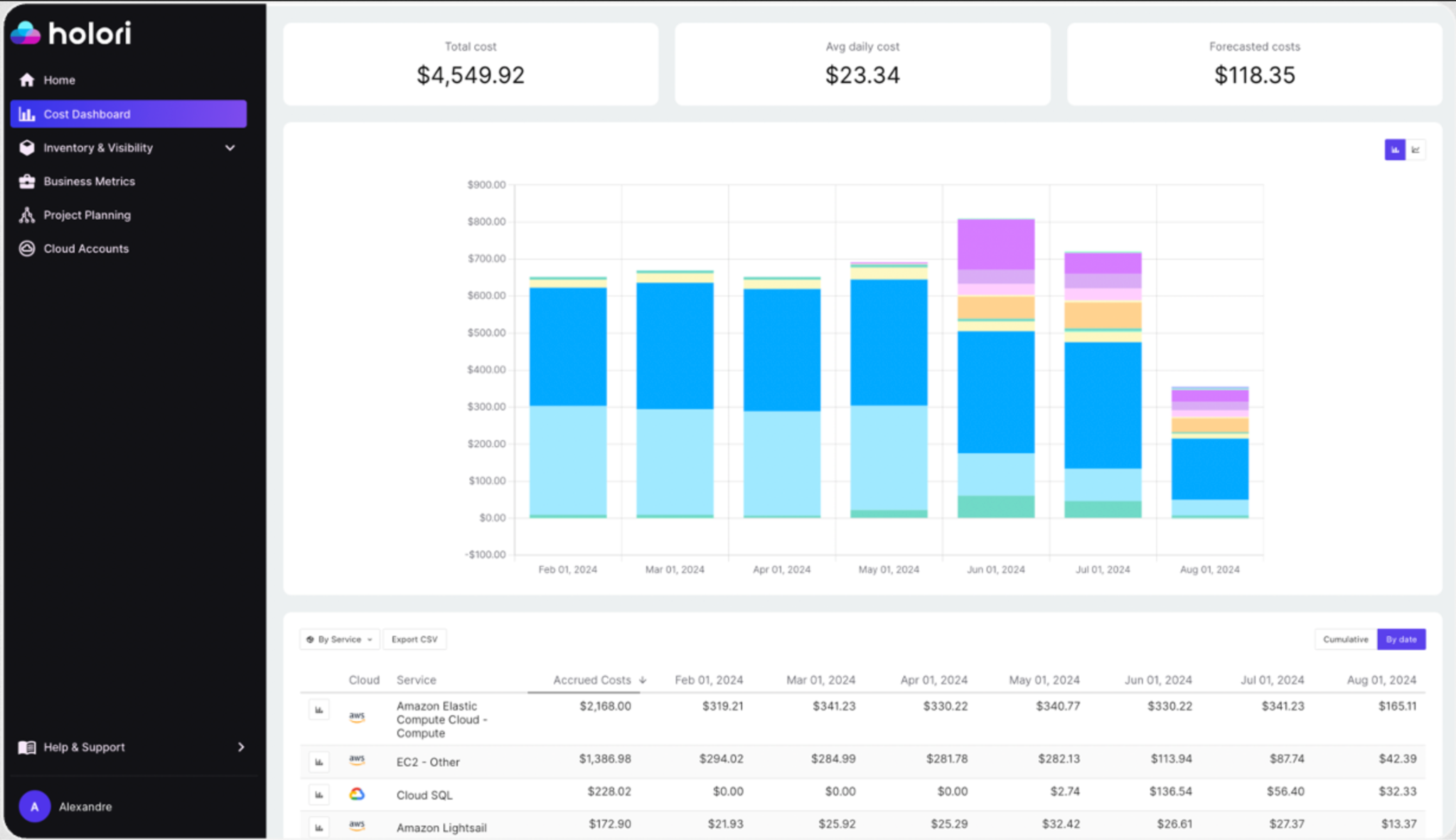
A FinOps certification teaches you the framework. Applying it every day is a different job, and that is where the right tooling matters as much as the credential itself. This is where a platform like Holori comes in. Holori is a FinOps and cloud cost management platform built with a bring your own cloud architecture, giving teams full cost visibility, cost allocation, and cross cloud optimization recommendations across AWS, Azure, GCP, and beyond, without ever having to hand over billing data to a third party.
Everything the AI Value and Technology Value certifications teach in theory, from tagging discipline to unit economics to governance across a mixed technology estate, is exactly what Holori helps FinOps teams put into practice day to day. Certified practitioners who pair their credential with a platform built for the Inform, Optimize, and Operate lifecycle tend to move from theory to measurable savings far faster than those relying on spreadsheets and native cloud consoles alone.
Whether you pursue FinOps Certified Practitioner as your first credential, go straight for the new AI Value certification given where cloud spend is heading, or aim for the full FinOps Certified Professional track, pairing that knowledge with the right tooling is what turns certification into real cost control.
Start your FinOps journey for free: app.holori.com