Are you evaluating CloudZero but concerned about its complexity and opaque pricing? This comparison breaks down CloudZero vs Holori on features, pricing, and user experience and why forward thinking teams are choosing Holori for faster insights, visual clarity, and genuine transparency.
TL;DR
- CloudZero is a unit economics-focused platform that requires significant configuration, assigns you a FinOps Account Manager (FAM), and uses tiered pricing that lacks transparency until you’re deep in sales conversations.
- Holori is a modern, visual FinOps platform that delivers powerful cost management, infrastructure visualization, and flexible allocation without the consultative overhead or pricing games.
If you want to calculate cost-per-customer metrics and are willing to spend weeks configuring complex dimensions with a dedicated account manager, CloudZero might work. But if you want immediate visibility, visual infrastructure diagrams, transparent pricing, and the ability to start optimizing costs within hours instead of weeks, Holori is the superior alternative.
Quick Comparison
Let’s compare CloudZero vs Holori around key features for modern FinOps tools.
| Area | CloudZero | Holori |
| Primary focus | Unit economics through complex data modeling; consultative implementation with assigned FAMs | Modern FinOps: intuitive cost allocation, immediate insights and infrastructure diagrams |
| Typical customer | Engineering-led orgs with mature FinOps teams; companies needing granular per-customer costs | Startups, scaleups, SMBs, and enterprises; teams seeking instant visibility without consultants |
| Key strengths | Sophisticated unit economics, extensive PaaS integrations, dedicated account managers | Virtual tagging, auto-generated diagrams, transparent pricing, fast self-service setup |
| Pricing model | Tiered and opaque: requires sales negotiation | Self-serve with free tier; Enterprise: flat 1% of tracked cloud spend, no minimums, fully transparent |
| Time to value | Weeks to months (configuration with FAM, dimension setup, dashboard building) | Hours to days (connect accounts, auto-generate diagrams, drag-and-drop allocation) |
CloudZero vs Holori: What Actually Makes Holori a Better alternative
1. Cost Allocation: Configuration Complexity vs Visual Simplicity
CloudZero: Uses “code-driven” cost allocation through its CostFormation engine. This approach requires defining allocation rules through configuration artifacts, working with your assigned FAM to set up custom dimensions, and understanding CloudZero’s proprietary data model.
While this eventually allows sophisticated allocation (including unit economics like cost-per-customer), it takes weeks to configure properly. You’re dependent on your FAM’s availability and expertise to build these dimensions correctly. Changes to your allocation strategy require reconfiguring these complex rules, which means more time and more FAM involvement.
The learning curve is steep. Finance teams struggle with the technical complexity, while engineers get frustrated waiting for configuration changes.
Holori: Uses virtual tagging through an intuitive drag-and-drop interface. You can allocate costs to teams, projects, cost centers, or any business dimension without touching cloud infrastructure or writing configuration code. Moreover, you can create tags independently of the providers’ tags.
This means:
- Start allocating costs immediately after connecting accounts
- No dependency on consultants or account managers
- Reorganize allocations in minutes as your business structure evolves
- Visual cost allocation trees that make hierarchies instantly clear
- Finance teams can manage allocation without engineering involvement
- Finance teams don’t need access to the cloud provider console
If you compare CloudZero vs Holori, you’ll notice that Holori’s approach is both more flexible and dramatically easier to use than CloudZero’s configuration-heavy methodology.
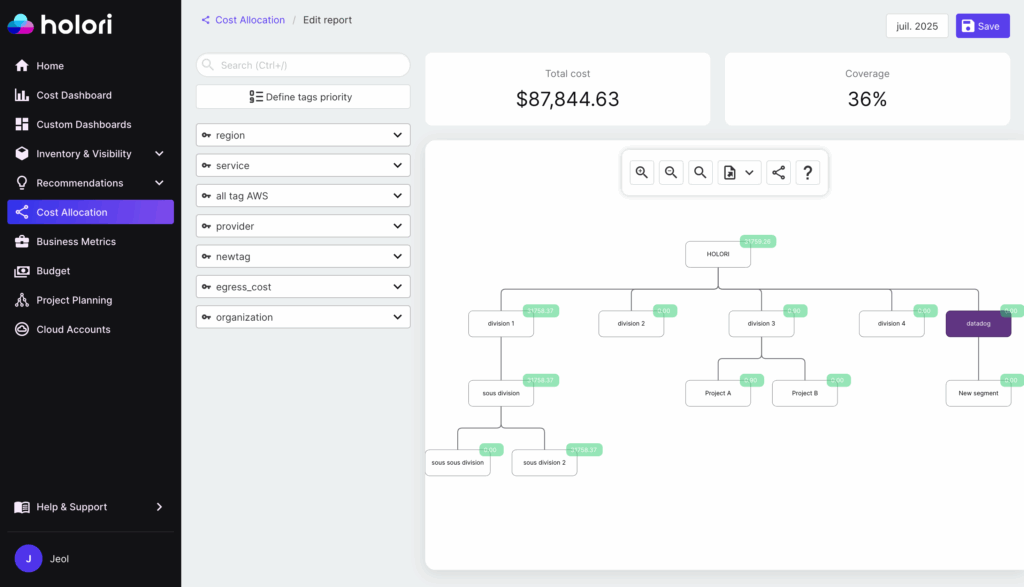
Bottom line: CloudZero requires weeks of configuration and ongoing FAM involvement to allocate costs. Holori lets you start allocating immediately through visual interfaces that anyone can use.
2. Visual Infrastructure Understanding: CloudZero’s Missing Piece
CloudZero: Provides… zero (if you see the joke) infrastructure visualization. The platform is entirely focused on cost data, dashboards, reports, and analytics around spending patterns. If you want to understand what’s actually running in your cloud, how resources connect, or where bottlenecks exist, CloudZero won’t help you.
Holori: Automatically generates interactive infrastructure diagrams that serve as living documentation. These visualizations show exactly what’s deployed, how resources connect, where they’re located, and how costs accumulate across your architecture.
Engineers get instant architectural clarity. Finance teams understand what they’re paying for without decoding cryptic service names. The diagrams auto-update as resources change, eliminating documentation drift entirely.
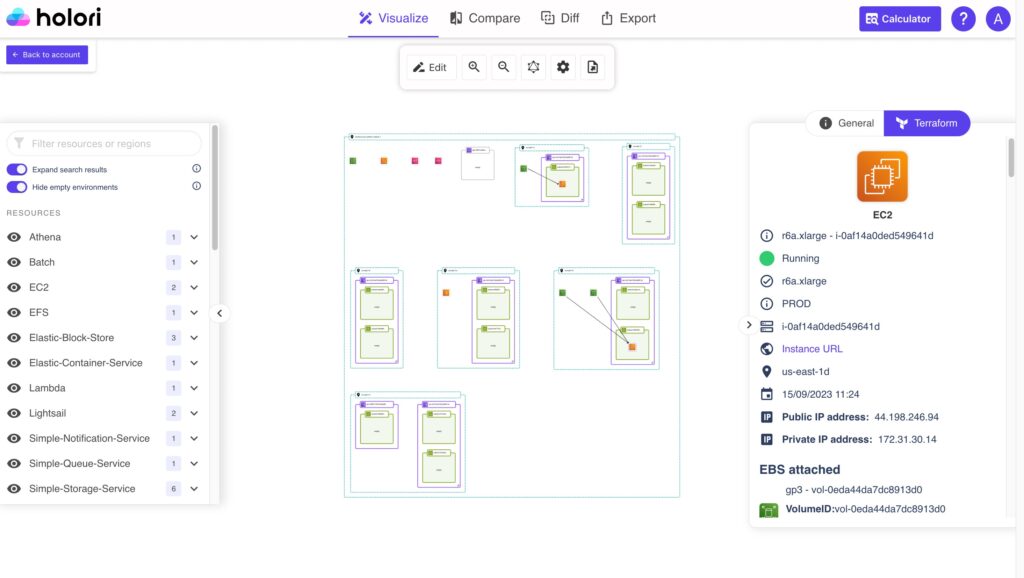
Bottom line: CloudZero makes you maintain infrastructure documentation separately. Holori gives you automatically updated diagrams alongside cost data, eliminating an entire category of operational overhead.
3. Transparency: Opaque Sales Process vs Clear Pricing
CloudZero: Pricing is completely opaque until you engage with their sales team. The tiered model means you pay different percentages at different spend levels but these numbers aren’t published.
You’ll spend hours in discovery calls, sales presentations, and negotiations just to learn what CloudZero actually costs. The pricing varies based on contract length (annual vs three-year), negotiation skills, and factors that aren’t transparent. Many teams report feeling frustrated by this sales-heavy process when they just want to understand the actual cost.
Even after signing, you’re dependent on renewal negotiations to maintain pricing. As your spend grows, you’re never quite sure if you’re getting competitive rates or being overcharged compared to other customers.
Holori: Pricing is published on the website, transparent, and simple:
- Free tier: Start immediately with basic features
- Pro plan: $49/month for cloud spend up to $10K
- Business plan: $199/month for cloud spend up to $20K
- Enterprise: Flat 1% of tracked cloud spend.
- No hidden fees: All features included at every tier
You can calculate exactly what Holori costs before talking to anyone. No sales games, no negotiation fatigue, no surprises. If you want to discuss enterprise requirements, the sales team helps with technical fit, not pricing pressure.
Bottom line: CloudZero makes you work to discover pricing through a sales process. Holori tells you the price upfront so you can make informed decisions.
4. Time to Value: Consultative Delays vs Self-Service Speed
CloudZero: Implementation is consultative and slow:
- Sales discovery calls and technical scoping
- Account connection and initial data ingestion
- Multiple sessions with your FAM to define unit metrics
- Configuration of custom dimensions and allocation rules
- Dashboard creation and iteration with your FAM
- Training sessions for engineering and finance teams
- Ongoing optimization reviews with your FAM
Timeline: Weeks to months before you’re seeing actionable insights.
This extended process creates dependency on your FAM’s schedule and expertise. If your FAM is managing multiple accounts or leaves CloudZero, your timeline extends further. While CloudZero claims you get “basic visibility quickly,” unlocking the platform’s real value requires this extensive configuration period.
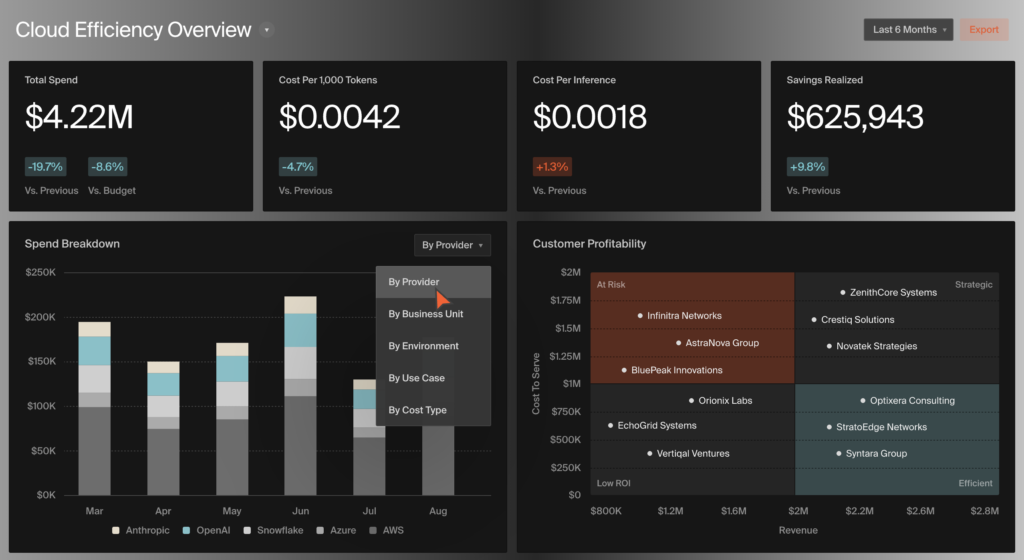
Holori: Implementation is self-service and fast:
- Connect your cloud accounts in a few minutes and wait for the data to be retrieved
- Holori auto-generates infrastructure diagrams (usually in a few minutes)
- Use drag-and-drop to allocate costs across teams
- Set up budget alerts and optimization recommendations
- Start identifying and acting on optimization opportunities
Timeline: Hours to days for full deployment and immediate insights.
Holori’s fast time to value means you validate ROI immediately, find quick wins in the first week, and iterate on your FinOps practices without waiting for consultant availability. Teams report finding thousands in monthly savings within the first 48 hours.
Bottom line: CloudZero’s consultative model delays value delivery by weeks or months. Holori’s self-service approach puts you in control with immediate results.
5. User Experience: Learning Curve vs Intuitive Design
CloudZero: Built for sophisticated users willing to invest in learning. The platform offers extensive customization through CloudZero Analytics, custom dimensions, and flexible reporting, but this power comes with significant complexity.
New users typically need multiple training sessions to navigate effectively. CloudZero’s value is partially locked behind this learning curve. If your team doesn’t invest weeks in training and configuration, you’ll never realize the platform’s full capabilities. This works fine for enterprises with dedicated FinOps teams, but it’s overkill for most organizations.
Holori: Designed with modern UX principles. The interface is clean, visual, and immediately understandable. Engineers can explore cost data without training because the visual approach is intuitive. Finance teams appreciate clear dashboards that don’t require technical expertise to interpret.
Visual infrastructure diagrams use familiar architectural concepts. Also, the drag-and-drop cost allocation feels natural. Optimization recommendations are actionable without deep cloud expertise. New team members become productive within hours instead of weeks.
Why this matters: Tool adoption drives value. If your team avoids using your FinOps platform because it’s too complex, you’re wasting money on software that doesn’t deliver ROI. Holori’s intuitive design means high adoption rates, which means faster optimization and better results.
Bottom line: CloudZero requires significant training investment to use effectively. Holori is intuitive from day one, driving faster adoption and better outcomes.
6. Multi-Cloud Support: AWS-Centric vs Truly Multi-Cloud
CloudZero: While CloudZero integrates with 50+ platforms including Snowflake, Databricks, and Datadog, this breadth comes at the cost of depth outside AWS. Teams running significant workloads on Azure or GCP often find features lag behind AWS capabilities.
The platform’s unit economics approach also works best for AWS environments where telemetry integration is most mature. Multi-cloud organizations may struggle to achieve the same granularity across providers.
Holori: Supports AWS, Azure, GCP, OCI, and OVHcloud with consistent feature parity across all platforms. The difference really lies in the depth of the billing details offered by each provider. The infrastructure visualization works identically whether you’re on AWS, Azure, or GCP, no second-class cloud providers.
Holori also covers modern platforms that CloudZero doesn’t prioritize:
- European cloud providers: OVHcloud, Scaleway for data residency compliance
- Modern services: Cloudflare, Datadog for comprehensive cost visibility
- Emerging platforms: Planned integration with cloud AI providers (OpenAI, Anthropic)
For teams with true multi-cloud architectures or those using European providers, Holori provides better coverage and more consistent experiences.
Bottom line: CloudZero is AWS-first with varying support quality for other clouds. Holori treats all clouds equally with consistent visualization and features.
7. The Unit Economics Question: Necessary Complexity?
CloudZero’s pitch: The platform’s headline feature is calculating unit economics, ie cost per customer, per API call, per transaction, per feature. The CostFormation engine combines billing data with application telemetry to attribute every dollar to specific business units.
The reality: Most organizations don’t need this level of granularity. Understanding costs by team, project, application, and environment provides sufficient insight for optimization decisions. The complexity of implementing true unit economics often outweighs the benefits unless you’re a multi-tenant SaaS company with sophisticated pricing models.
CloudZero’s unit economics require:
- Extensive telemetry integration between cloud and application
- Ongoing configuration and maintenance of allocation rules
- Dependency on FAM expertise to set up correctly
- Complex data modeling that most teams struggle to utilize fully
Holori’s approach: Provides clear cost allocation by business dimensions (teams, projects, cost centers, applications) without the overhead of transaction-level granularity. For 90% of organizations, this delivers the actionable insights they need without unnecessary complexity.
Moreover, if you later determine you need deeper unit economics, you can implement this through data warehouse analysis using Holori’s allocation data as a foundation. But most teams find they don’t actually need cost-per-transaction metrics, they need to know which team or project is driving costs so they can optimize accordingly.
Bottom line: CloudZero vs Holori is here a tight match. CloudZero’s unit economics are impressive but overkill for most teams. Holori provides the practical cost allocation that actually drives optimization without forcing you to pay for sophistication you don’t need.
Pricing: The Real Cost Comparison
CloudZero Pricing Reality
CloudZero’s tiered pricing sounds attractive in principle but lacks transparency in practice. You need to request a custom quote.
Hidden costs:
- Time investment: Weeks of your team’s time during implementation
- FAM dependency: Ongoing reliance on consultant availability for changes
- Negotiation overhead: Hours spent in sales conversations just to learn actual pricing
- Contract lock-in: Multi-year commitments required for best pricing
Example: A team with $5M annual cloud spend might pay $50,000-60,000/year after negotiation. But you’ll spend numerous hours in sales conversations to discover this, and you’ll be locked into multi-year contracts to get the lower end of that range.
Holori pricing
Holori starts at 1% of the tracked spend. The more you spend on your cloud the less percentage we charge.
The Dependency Problem: FAMs as Feature or Friction?
CloudZero’s FAM Model
CloudZero assigns every customer a FinOps Account Manager who becomes your primary interface to the platform. The FAM:
- Configures custom dimensions and allocation rules
- Builds dashboards and strategic visualizations
- Conducts monthly review sessions
- Implements “prescriptive best practices”
- Serves as your FinOps consultant
CloudZero frames this as a benefit: You get dedicated expertise as an extension of your team.
The reality: You become dependent on someone else’s availability and expertise. Want to adjust an allocation rule? Schedule time with your FAM. Need a new dashboard? Work with your FAM. Want to understand a cost spike? Wait for your FAM’s analysis.
This consultative model creates bottlenecks:
- Your optimization speed depends on your FAM’s calendar
- Knowledge stays with the FAM instead of your team
- FAM turnover disrupts your FinOps practices
- You’re paying CloudZero partly for services that should be self-service
For teams with limited internal FinOps expertise, FAMs might seem valuable initially. But they create long-term dependency that slows down optimization and keeps institutional knowledge outside your organization.
Holori’s Self-Service Model
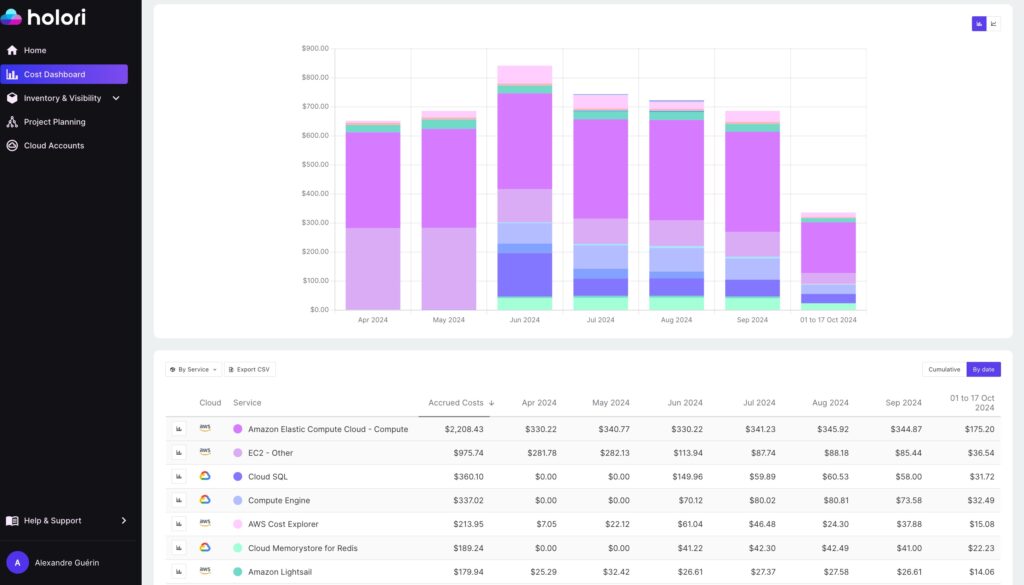
Holori provides excellent support when you need it, but the platform is designed for self-service from day one. Your team:
- Connects accounts and starts using features immediately
- Configures allocation rules through intuitive interfaces
- Creates dashboards with drag-and-drop simplicity
- Identifies optimizations without waiting for consultants
- Builds FinOps expertise internally instead of outsourcing it
This self-service approach means:
- Faster optimization: Act on insights immediately instead of scheduling consultant time
- Team empowerment: Your engineers and finance staff develop FinOps skills
- No bottlenecks: Changes happen when you want them, not when consultants are available
- Knowledge retention: Expertise stays within your organization
Support is available when you need it, but you’re never blocked waiting for a consultant to implement changes you could make yourself in an intuitive interface.
Bottom line: CloudZero’s FAM model creates dependency disguised as service. Holori’s self-service approach empowers your team to own FinOps without consultant bottlenecks.
When CloudZero Might Make Sense
CloudZero can be the right choice if:
- You’re a multi-tenant SaaS company where precise cost-per-customer metrics directly inform pricing strategy
- You have dedicated FinOps engineers who will spend weeks mastering complex configuration
- Your stack is heavily AWS-focused with extensive Snowflake/Databricks usage
- You genuinely prefer consultative implementation over self-service tools
- You’re prepared for multi-week onboarding to achieve sophisticated capabilities
- Your finance team demands transaction-level cost attribution for business metrics
Conclusion: CloudZero vs Holori : Which alternative is best?
Most cloud teams need:
- Immediate visibility into what’s running and what it costs
- Visual understanding that makes infrastructure comprehensible to everyone
- Flexible allocation that works regardless of tagging maturity
- Fast implementation that delivers value in days, not weeks
- Transparent pricing without sales negotiations
- Self-service tools that don’t require consultants for every change
CloudZero offers sophisticated unit economics for teams willing to invest weeks in configuration and accept ongoing consultant dependency. For the narrow use case of multi-tenant SaaS companies needing transaction-level cost attribution, this complexity might be justified. But Holori comes out as a stronger alternative than Cloudzero.
Holori represents the modern approach: visual infrastructure diagrams, intuitive cost allocation, transparent pricing, and fast self-service implementation. It delivers the capabilities that 90% of teams actually need without forcing you to pay for and maintain complexity you’ll never use.
Choose CloudZero if you’re certain you need its specific sophistication and are prepared for its drawbacks. Choose Holori if you want immediate value, visual clarity, and a platform that respects your time and intelligence with transparent pricing and self-service tools.
FAQ: CloudZero vs Holori
Can Holori calculate unit economics like CloudZero?
Holori provides cost allocation by team, project, and business dimension, which covers what most organizations actually need. CloudZero’s transaction-level unit economics are sophisticated but overkill unless you’re a multi-tenant SaaS company with complex pricing models. If you later need deeper unit economics, you can build this in your data warehouse using Holori’s allocation data as a foundation.
Does CloudZero provide infrastructure diagrams?
No. CloudZero focuses exclusively on cost data and provides zero infrastructure visualization. You’ll need separate tools for architecture documentation, which inevitably becomes outdated. Holori’s auto-generated diagrams eliminate this problem entirely by visualizing your infrastructure alongside costs.
How long does each platform take to implement?
Holori delivers value within hours to days, connect accounts, get instant diagrams, set up allocation via drag-and-drop. CloudZero requires weeks to months of configuration with your assigned FAM to define dimensions, build dashboards, and implement unit economics properly. If you need fast results, Holori wins dramatically.
What about CloudZero’s FinOps Account Managers?
CloudZero frames FAMs as a benefit, but they create dependency. Every configuration change, dashboard update, or allocation adjustment requires scheduling time with your FAM. This consultative model slows down optimization and keeps knowledge outside your organization. Holori’s self-service approach lets you make changes instantly without consultant bottlenecks.
Is Holori’s pricing really that much clearer?
Yes. Holori publishes pricing on the website: $49/month for Pro, $199/month for Business, 1% for Enterprise. CloudZero’s tiered percentages require sales conversations to discover actual costs, and pricing varies based on negotiation. If you value your time and hate sales games, Holori’s transparency is refreshing.
Can I use Holori without perfect cloud tagging?
Yes, this is one of Holori’s core advantages. Virtual tagging lets you allocate costs via drag-and-drop without depending on resource tags. CloudZero’s CostFormation approach also handles imperfect tagging, but requires complex configuration with your FAM. Holori’s visual method delivers results immediately. Ready to give it a try? Simply create an account and get started.
Does Holori work for large enterprises?
Absolutely. Holori’s Enterprise plan scales to any size with flat 1% pricing and all features included. The self-service model actually works better at scale, large teams can iterate on FinOps practices without scheduling consultant time across multiple groups. CloudZero’s tiered pricing becomes more competitive at $25M+ spend, but you’re still dependent on FAM availability for changes.
What if I’m already using CloudZero?
Many teams migrate from CloudZero to Holori when they realize they’re paying for sophistication they don’t use while missing infrastructure visualization they actually need. Holori’s migration process is straightforward, and most teams report being fully operational faster than their original CloudZero implementation took.
How does Holori’s visual approach actually help?
Infrastructure diagrams make cloud architecture instantly understandable to everyone, engineers see how resources connect, finance understands what they’re paying for, executives grasp the big picture. This visual context accelerates optimization because teams can identify issues spatially rather than hunting through tables. CloudZero’s spreadsheet-style approach requires more interpretation and provides no architectural context.