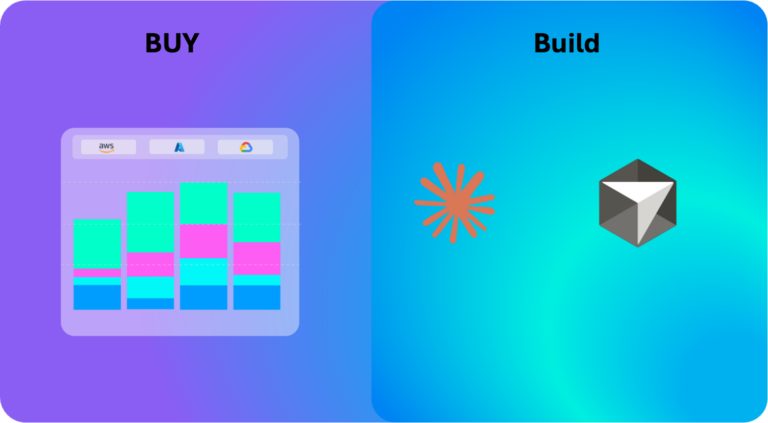
For years, the build vs buy decision for a FinOps platform was mostly a resourcing question. Did you have the engineering capacity to build and maintain it? In 2026, AI coding assistants have made that question feel almost irrelevant. If a senior engineer with Claude or Copilot can ship in one week what used to take three, surely building an internal cloud cost management platform is back on the table.
This is the assumption worth stress-testing. AI does lower the barrier to building. But it does not lower the cost of owning what you build, the risk of data accuracy problems, or the growing gap between what an internal tool can realistically do and what a mature FinOps practice actually needs. This article runs the numbers and makes the case that AI makes the build vs buy equation harder for the build side, not easier.
What Building a FinOps Platform Actually Involves
Before getting to costs, it is worth being precise about the scope. This is where most build decisions go wrong: teams scope for the MVP they need today, not the platform they will need in twelve months.
A functional FinOps platform in 2026 needs to ingest and normalize billing data from multiple cloud providers, each using a different schema, a different export format, and a different update cadence. AWS Cost and Usage Reports have up to 125 columns in their current version and AWS continues adding new ones, most recently in November 2025 for capacity reservation tracking. GCP billing exports through BigQuery use a completely different data model. Azure has its own quirks. Normalizing these into a consistent internal schema is not a weekend project.
You might reasonably point to FOCUS here. The FinOps Open Cost and Usage Specification was designed exactly to solve this problem by giving all providers a common billing schema. It is a genuine step forward and worth knowing about. But it does not make the build argument significantly easier for three reasons.
First, provider adoption is still partial: not all services from all providers export FOCUS-compliant data yet, which means you still need to handle non-FOCUS billing data for meaningful portions of your bill. Second, FOCUS is a spec, not a tool. It tells you what the data should look like but gives you nothing on top of it: no ingestion pipeline, no allocation logic, no dashboards, no anomaly detection. Third, the spec itself evolves. FOCUS 1.1 introduced breaking changes from 1.0, and building against a living standard means your pipeline needs to track and adapt to those revisions over time. FOCUS reduces one layer of normalization complexity. The hard parts of building a FinOps platform remain entirely on you
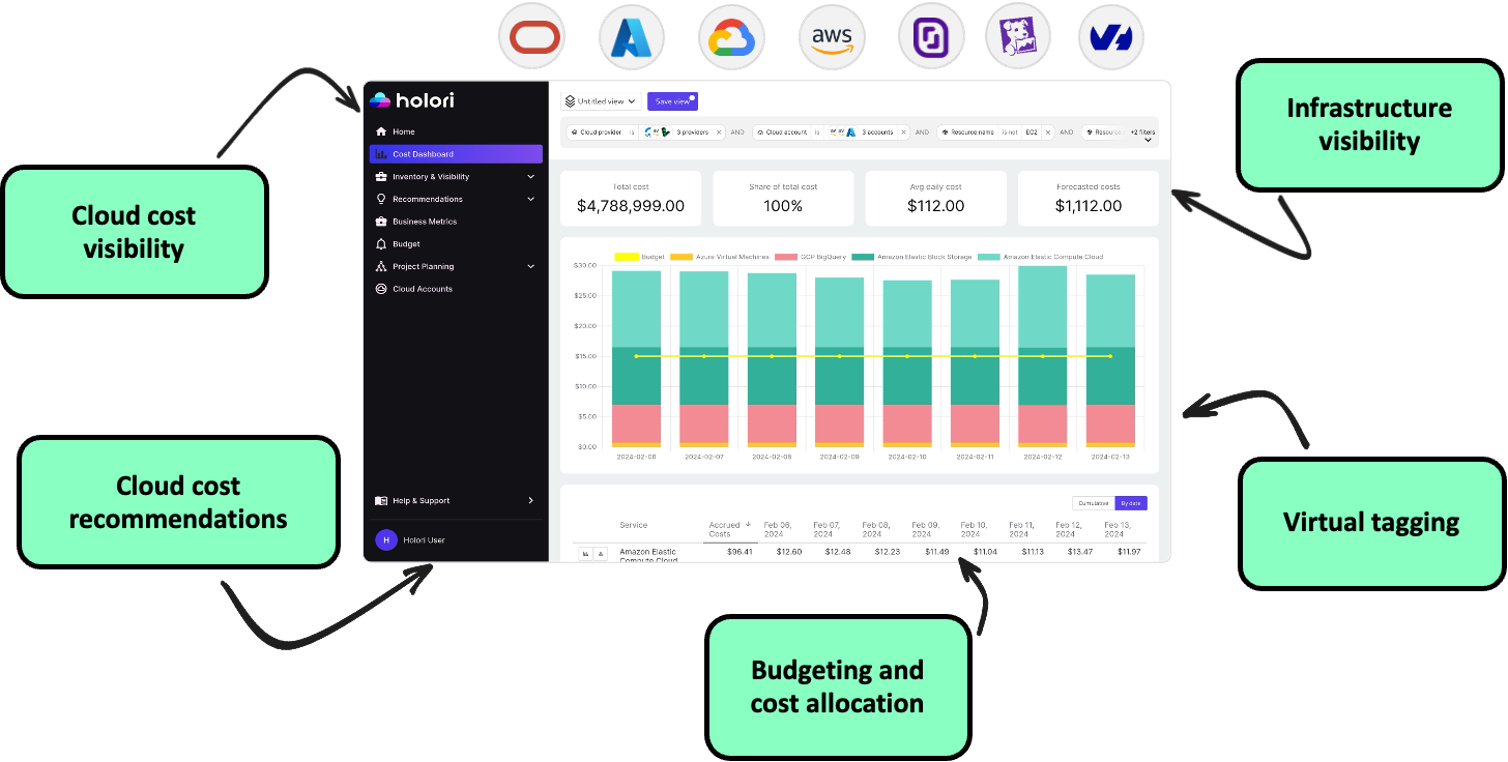
Beyond ingestion, you need cost allocation logic that handles shared resources and untagged spend. You need virtual tagging so allocation rules can be defined without retagging infrastructure. You may need anomaly detection, commitment management, dashboards, budget alerts, showback and chargeback reports, RBAC, SSO, and an API. That is the feature surface of a mature FinOps platform. It is also roughly what commercial tools such as Holori have spent years building and continue to maintain as providers change their data formats and pricing models.
What AI Actually Changes
AI coding assistance is real and genuinely useful. A feature that took three weeks now takes one. That matters and should not be dismissed.
But AI has also raised the bar for what a FinOps platform needs to do to be considered complete. Agentic FinOps workflows, natural language cost querying, automated anomaly response, AI-assisted commitment recommendations: these are becoming more and more èustandard capabilities in commercial platforms. Building them internally requires not just AI coding speed but ML expertise, model evaluation infrastructure, and the kind of continuous tuning a dedicated product team can sustain and an internal tool team cannot.
AI lowers the barrier to building a basic cost dashboard. It simultaneously raises expectations for what a cost management platform should do. The net effect on the build vs buy calculation is not neutral. It pushes further toward buy for any organization operating at meaningful cloud scale.
What It Actually Looks Like in Practice
Take a realistic scenario: two senior engineers, Claude Sonnet as their main coding assistant. In the first two weeks they ship an AWS CUR ingestion pipeline, GCP billing normalization, basic allocation logic, and a working dashboard. Token spend: around $400. The output is genuinely solid and the team feels good about the decision.
By month four, the picture is different. GCP credit edge cases surfaced in production. A third provider was added. Shared infrastructure had no clean ownership signal and the allocation logic needed rebuilding. The two engineers are still on it. Total token spend: around $800. Total salary cost for four months: around $160K. The platform does the basics. Commitment management, anomaly detection, and Kubernetes allocation are still on the roadmap.
That $4000 in tokens is irrelevant. The $160K in salary is not. At roughly $40K per month for two engineers, it keeps running every month after that.
The Cost Comparison : Build vs Buy Cloud cost management tool
In the US, two engineers working on an internal FinOps platform for a full year cost roughly $480K in salary and overhead. A commercial FinOps platform for a company spending $600K per month on cloud typically runs $40K to $180K per year. The gap is large enough that the math works even if the engineers ship faster than expected, and even if the platform covers 80% of what a commercial tool does. The remaining 20%, commitment management, anomaly detection, Kubernetes allocation, is usually exactly the 20% that matters most to the FinOps team asking questions.
There is also an opportunity cost that rarely makes it into the calculation. While your two engineers are spending month one on billing ingestion, your FinOps team has zero visibility. No anomaly detection catching a runaway cost spike. No commitment recommendations. No allocation reports for the engineering leads asking where their budget went. That silence has a price too, and it compounds every week the build is still in progress.
| Build (internal) | Buy (Holori) | |
|---|---|---|
| Year 1 cost | ~$480K (2 engineers, salary + overhead) | $40K to $180K/year |
| Time to first insight | 3 to 4 months minimum | Day one |
| Multi-cloud support | Built incrementally, per provider | AWS, Azure, GCP out of the box |
| Anomaly detection | Roadmap item | Included |
| Commitment management | Roadmap item | Included |
| Kubernetes allocation | Roadmap item | Included |
| Provider schema updates | Your engineering backlog | Handled by Holori |
| Ongoing maintenance | ~$240K/year (1 engineer) | Included in subscription |
When Building Still Makes Sense
The case for building is not dead, but it really depends on the needed scope.
If your cloud spend is concentrated in a single provider, your organizational structure is simple, and your requirements stop at basic visibility and cost tracking, a lightweight internal tool might be the right call. Some teams genuinely are in this situation.
The other legitimate case is a specific, well-scoped extension on top of a commercial platform: a custom unit economics model tied to proprietary business metrics, or a specialized allocation workflow for a unique organizational structure. Building a specific integration is very different from building the platform itself.
The Ownership Question Nobody Asks Up Front
There is one dimension of the build vs buy decision that consistently gets underweighted and consistently causes problems: who owns this platform when the engineers who built it move on?
Internal tools inherit the knowledge of the people who built them. When that person leaves or shifts priorities, the platform stagnates. Provider schema changes sit unresolved. Bugs in allocation logic stay in the backlog. A number that finance depends on starts drifting and nobody is sure why.
There is also a conflict of interest problem that rarely gets discussed. The person responsible for reporting on cloud costs should not be the same person who built the system generating those reports. When numbers look wrong, it is very hard to investigate clearly if you are also the one who wrote the allocation logic. In a commercial platform, the vendor owns the accuracy of the data. In an internal tool, that responsibility sits with whoever built it, which creates a murky accountability structure at exactly the moment when clarity matters most.
Data accuracy is harder to maintain than it looks. When you update cost allocation logic, the effects ripple into budget reports, chargeback models, and forecasts in ways that are hard to trace and even harder to explain to finance stakeholders. A commercial platform treats a data accuracy issue as a P1 incident. An internal tool treats it as a ticket competing with everything else on the roadmap.
This is not a solvable engineering problem. It is an organizational one. A commercial FinOps platform has a dedicated team whose entire job is making sure the platform stays current and accurate. An internal tool has whoever has bandwidth this sprint.
For teams that have gone through a build-then-buy cycle, the most common reflection is not that the build was a mistake at the time. It is that the ongoing cost of ownership accumulated much faster than anticipated, and the decision to buy should have come sooner.
Conclusion: Build vs Buy FinOps platform
The question is not whether AI makes building possible. It clearly does, faster than ever.
The question is whether the engineering time, the domain expertise, the ongoing maintenance, and the opportunity cost of two or three engineers not working on your actual product for several months is a better investment than a subscription that gives you the same capability on day one.
For most teams spending more than $100K per month on cloud, across multiple providers, with real cost allocation and optimization requirements, the answer is no. AI makes building faster. It does not make it cheap.
Try Holori now for free: https://app.holori.com/
Frequently Asked Questions
Is it cheaper to build a FinOps platform with AI in 2026?
AI reduces the time to write code, but it does not reduce the cost of owning what you build. Engineering salaries, ongoing maintenance, provider schema updates, and accuracy issues all remain. Two engineers working on an internal platform for a year still cost around $480K. A commercial FinOps platform typically costs $40K to $180K per year. AI compresses the build timeline modestly. It does not close that gap.
How long does it take to build a basic cloud cost management platform?
With two engineers and heavy AI assistance, a working MVP covering two to three cloud providers, basic cost allocation, and dashboards takes roughly three to four months. That is before anomaly detection, commitment management, Kubernetes cost allocation, RBAC, SSO, and the other features FinOps teams typically need within the first year. Each of those adds months on top.
What are the biggest hidden costs of building internally?
The two most underestimated costs are maintenance and accuracy. Cloud providers change their billing data formats regularly, and every change requires engineering time to diagnose and fix. Cost allocation logic updates can silently shift the numbers that finance and engineering stakeholders depend on, in ways that are hard to trace and harder to explain. These are ongoing costs that start the day you ship, not one-time investments.
When does building make sense?
Building makes sense when your environment is genuinely simple: one or two cloud providers, a small team, and requirements that stop at basic visibility. It also makes sense for specific, well-scoped extensions on top of a commercial platform, such as a custom unit economics model or a specialized allocation workflow. Building a targeted integration is very different from building and maintaining the platform itself.
Who should own an internal FinOps platform?
This is the question most teams do not ask until it becomes a problem. The person responsible for the accuracy of cost reports should not be the same person who built the system generating them. When numbers look wrong, investigating clearly is very difficult if you also wrote the allocation logic. Clear ownership and a separation between building and reporting are essential, and hard to maintain in practice with an internal tool.
Holori is a multi-cloud FinOps platform that gives engineering and finance teams unified cost visibility across AWS, Azure, GCP, and more, without the engineering investment of building it yourself. Book a demo to see what day-one coverage looks like.