AI budgeting used to mean adding a line item for a few API subscriptions. That era is over. Heading into 2027, AI spend touches infrastructure, talent, governance and dozens of per-token invoices that shift every month. Finance teams that still plan AI budgeting the way they plan traditional software costs are getting surprised by their own bills.
This guide breaks down how AI budgeting works today, why it keeps breaking traditional forecasting models, and which tools and techniques actually keep spend under control. Whether you run a five-person startup or a global enterprise, the same core discipline applies: treat AI budgeting as an operating capability, not a one-time approval.
What Is AI Budgeting?
AI budgeting is the process of planning, allocating and tracking the money an organization spends on artificial intelligence. That includes model APIs, GPU infrastructure, data preparation, AI talent, and the governance layer needed to keep all of it accountable.
Unlike a traditional software budget, AI budgeting rarely follows a flat subscription curve. Model usage scales with product adoption, and a single feature launch can multiply token consumption overnight. This is why AI budgeting increasingly sits at the intersection of finance, engineering and product, rather than inside one department alone.
A mature AI budgeting process answers three questions at all times. What are we spending right now? Which team, feature or customer is driving that spend? And is the return large enough to justify the next dollar?
Why 2027 Is a Turning Point for AI Budgeting
AI spend has moved from experimentation to a permanent, governed line item. Gartner’s most recent forecasts put global AI spending near $2.5 trillion in 2026, growing several times faster than overall IT budgets, and most analysts expect that trajectory to continue into 2027 as agentic AI and production workloads scale further.
The number that should worry every finance leader is not the total spend. It is the gap between confidence and control. Surveys from Flexera and NVIDIA both show that the large majority of enterprises plan to raise their AI budgets again, yet most still cannot fully attribute that spend to a specific team, product or outcome. A large share of IT leaders also report AI charges they never budgeted for in the first place.
That gap is exactly why AI budgeting has become its own discipline for 2027. Three forces are driving it.
Agentic workloads are multiplying costs. An autonomous agent does not make one model call, it can trigger dozens of chained calls, tool invocations and retries per task, and each one carries its own cost.
Model pricing keeps shifting. New model releases change price per token every few months, and teams that do not re-evaluate their model mix quietly overpay for capability they no longer need.
Governance is now a budget line, not an afterthought. Industry data shows governance and oversight now account for a growing share of total AI spend, as organizations build the review processes that regulators and boards expect.
The Hidden Cost Drivers Behind AI Budgets
Most AI budgeting failures do not come from one bad decision. They come from cost drivers that stay invisible until the invoice arrives.
Token and Inference Costs
Token spend is the hardest AI cost to forecast because it depends on user behavior, not a fixed contract. Input tokens, output tokens, cached tokens and reasoning tokens are often billed at different rates, and output tokens can cost several times more than input tokens on the same request. A single prompt change or a new feature that generates longer responses can quietly double a team’s monthly bill.
GPU and Infrastructure Spend
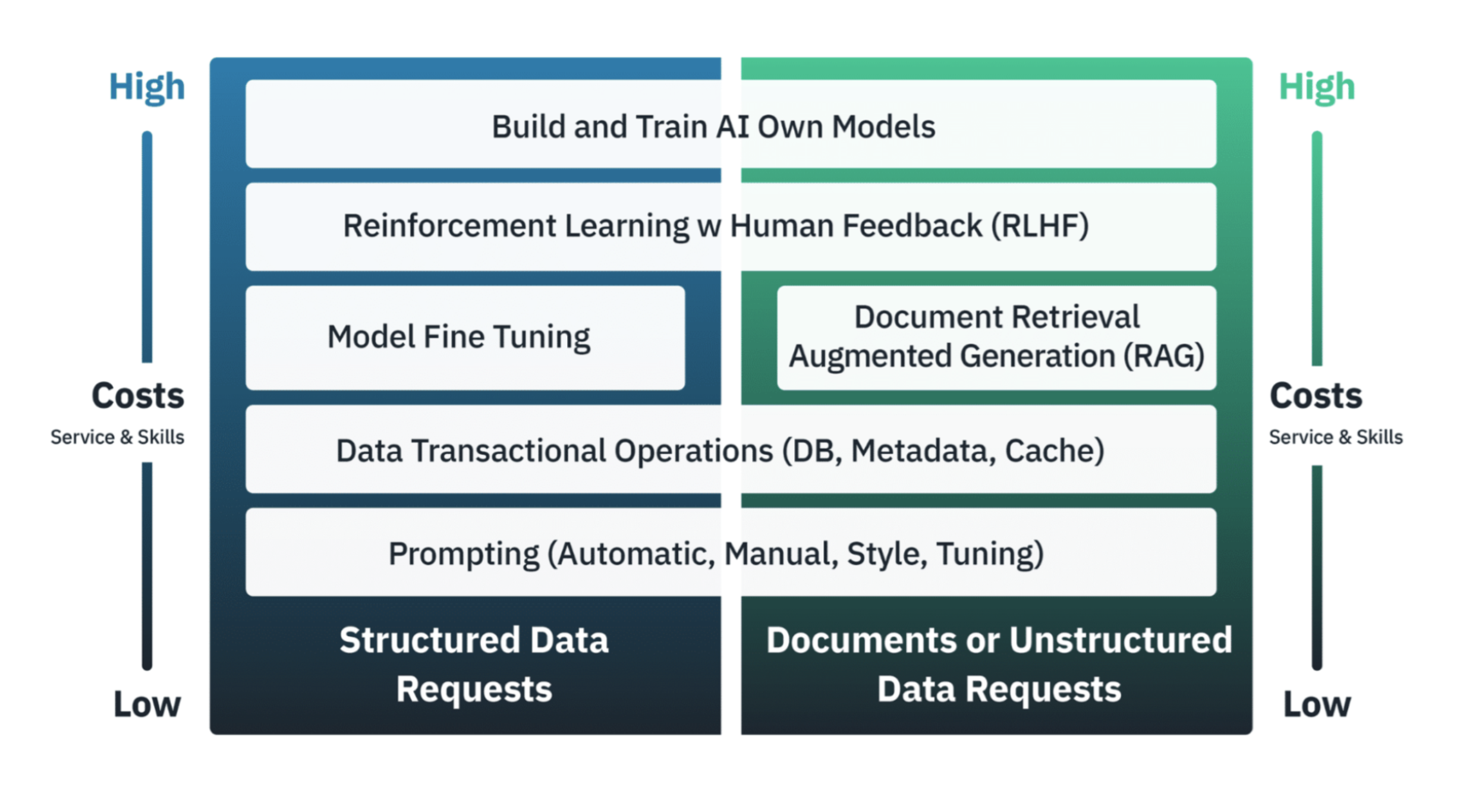
Training and fine-tuning workloads still depend on GPU capacity, and demand for that capacity continues to outpace supply in most regions. Idle or oversized GPU clusters remain one of the most common sources of AI budgeting waste, particularly for teams that provisioned capacity for a pilot and never resized it for production.
Agentic Workflows and Tool Calls
Multi-step agents introduce a cost pattern traditional budgeting was never built for. A single user request can trigger a chain of model calls, retrieval steps and external tool invocations, and a poorly bounded agent can loop far more times than expected. Without guardrails on recursion depth and total calls per task, agentic workflows are the fastest-growing source of AI budget overruns going into 2027.
Talent, Training and Governance
AI budgeting also covers the people side: data scientists, ML engineers, AI product managers, and the AI literacy training organizations now fund to drive safe, effective adoption across non-technical teams. This operational layer rarely shows up in a vendor invoice, which is exactly why it gets under-budgeted.
Building an AI Budgeting Framework
A credible AI budgeting framework starts by separating spend into clearly named buckets, because most budget disputes happen when finance, engineering and product are talking about different things without realizing it.
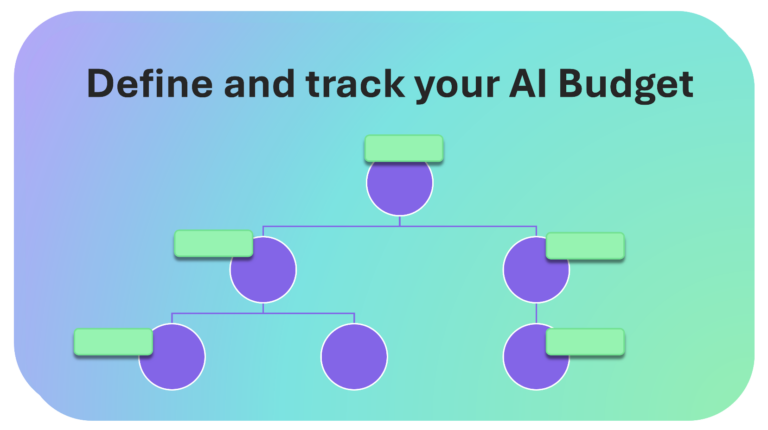
Start by defining the buckets explicitly: model and API costs, infrastructure and GPU costs, data preparation, talent, tooling, and governance. Give each bucket an owner, because a bucket with no owner never gets optimized.
Next, connect every AI cost to a unit of value. Cost per request, cost per customer, or cost per resolved ticket turns an abstract bill into a number a non-technical stakeholder can act on. This single step is what separates AI budgeting that supports decisions from AI budgeting that only reports history.
Then build a forecasting model that reacts to usage, not just to contracts. Because token spend scales with adoption, a flat monthly forecast will always be wrong. A usage-based forecast that updates as product metrics change gives finance a far more honest picture heading into each quarter.
Finally, set review cadence before spend becomes a surprise. Monthly reviews catch drift early. Waiting for a quarterly close to notice a cost spike means the damage is already three months old.
Best AI Budgeting Tools for 2027
No single tool covers every layer of AI budgeting. Most teams above a moderate spend threshold need at least two: one for token-level LLM visibility, and one for the broader cloud and infrastructure spend it runs on.
LLM and Token Cost Tracking
These tools sit close to the model calls themselves and answer the question a provider invoice cannot: which feature, prompt or customer generated this specific cost.
Langfuse is an open-source option that traces cost down to individual prompts and generations, splitting spend across input, output, cached and multimodal tokens. Helicone and Portkey work as lightweight proxies that log per-request cost and latency with minimal setup. LiteLLM normalizes pricing across more than a hundred providers behind a single API, which is useful for teams that route requests across multiple models. For agent-heavy workloads specifically, dedicated agent observability tools are emerging to track tool calls and recursive loops that request-level tracking alone misses.
Cloud and AI FinOps Platforms
Once AI spend is tied to cloud infrastructure, the question shifts from “what did this call cost” to “what does this feature cost end to end, across compute, storage and model spend combined.” CloudZero and Vantage both extend classic cloud cost tools to ingest token spend alongside compute, storage and networking, giving finance one place to see the full picture. Datadog’s LLM observability module does the same for teams already standardized on Datadog for infrastructure monitoring.
Multi-Cloud and BYOC Cost Visibility
For organizations running AI workloads across AWS, Azure and Google Cloud at the same time, cost attribution gets harder, not easier, as spend spreads across providers with different billing formats and discount structures. This is the layer where a FinOps platform built for multi-cloud environments earns its keep, normalizing cost data from every provider into one model instead of forcing finance to reconcile five different invoice formats by hand.
How Holori Solves the AI Budgeting Problem
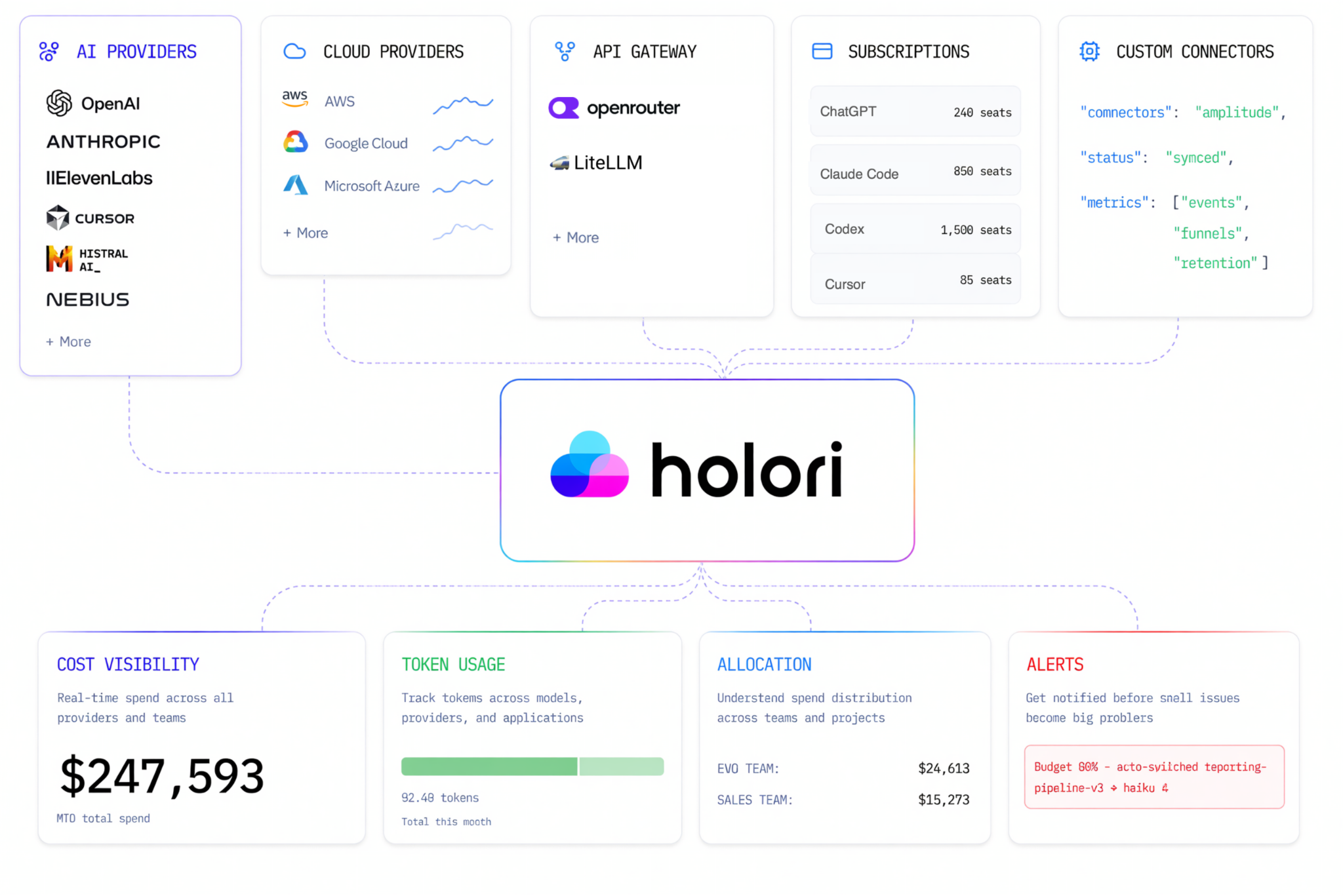
Most AI budgeting tools solve one layer of the problem. They track tokens, or they track cloud infrastructure, rarely both in the same view. That split is exactly where AI budgeting breaks down, because a single AI feature usually spends money on both at once: a model API call and the cloud infrastructure that surrounds it.
Holori was built to close that gap. It brings AI and cloud FinOps into a single platform, so AI budgeting stops being a reconciliation exercise between two separate dashboards.
One view for AI and cloud spend combined
Holori normalizes and visualizes AI spend from OpenAI, Anthropic, AWS Bedrock, Vertex AI, Azure OpenAI and LiteLLM alongside AWS, Azure, GCP and OCI cloud costs. Instead of checking a model provider’s console and a cloud billing console separately, finance and engineering see the full cost of an AI feature in one dashboard. That combined view is what turns AI budgeting from a monthly guessing game into an actual forecasting exercise.
Token-level tracking across every model
Holori monitors token consumption model by model, breaking down input and output usage, adoption trends and consumption patterns across the whole AI stack. Because output tokens are typically billed at a premium over input tokens, this level of detail is what catches a costly prompt or a verbose model response before it becomes a recurring line item nobody questioned.
Allocation that makes AI budgeting fair
AI provider invoices rarely reflect how AI is actually consumed inside an organization. Holori’s Virtual Tags let teams distribute token, inference and subscription costs across departments, projects, products or customers, without needing engineering to rebuild tagging pipelines by hand. That allocation layer is what makes chargeback and showback realistic instead of aspirational, and it is the single biggest lever for getting teams to self-regulate their own AI usage.
Budgets, thresholds and alerts before the bill arrives
AI budgeting only works if it is enforced before the invoice, not after. Holori lets teams define a budget, allocate it to specific views, resources or tags, and see the threshold plotted directly against real spend. When usage approaches that threshold, alerts fire by email or Slack, covering cost spikes, unusual token consumption and budget overruns across AI providers, cloud AI services and LLM gateways. Given that close to two in five organizations still exceed their planned cloud budget, that early warning layer is what separates a controlled AI budgeting process from a reactive one.
Estimate before you commit
Holori’s graphical cloud calculator lets teams design and price an architecture before it is deployed, so an AI budgeting decision is based on a real cost estimate rather than a rough guess. Planning the cost of a new AI feature before it ships is far cheaper than discovering it in production three months later.
Why sovereignty matters for AI budgeting
AI usage data is sensitive by nature: it can reveal what a company is building, which customers are heavy users, and how a product actually works. Holori’s FinOps platform is built around this concern, keeping cost and usage data inside the organization’s own environment rather than requiring it to flow through a third-party black box. For any organization treating AI budgeting as a governance function and not just a finance one, that distinction matters as much as the dashboard itself.
Techniques to Control AI Costs Without Slowing Innovation
Cutting AI budgets across the board almost never works, because it punishes high-value use cases along with wasteful ones. The techniques that actually hold up in 2027 target waste specifically.
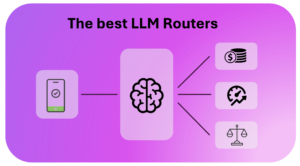
Model routing sends each request to the cheapest model capable of handling it, reserving frontier models for tasks that genuinely need their extra capability. Teams that default every request to the most expensive model available are one of the most common sources of unnecessary AI spend.
Semantic caching stores and reuses responses to similar or repeated prompts, cutting token spend on high-frequency queries without any change to user experience.
Right-sizing GPU capacity means matching cluster size to actual utilization instead of the peak load from an early pilot. Regular utilization reviews catch this drift before it becomes a permanent overspend.
Rate limits and recursion guards on agentic workflows cap the number of tool calls and chained requests a single task can trigger, which contains the runaway-loop scenario that drives the largest single-incident overspends.
Chargeback and showback models attribute AI cost back to the team or product that generated it. Teams that see their own AI bill change their usage patterns far faster than teams that only hear about cost in a quarterly finance review.
AI Budgeting Best Practices Checklist
A few habits separate organizations with AI budgeting under control from those still finding out their bill in arrears.
- Name every cost bucket and assign an owner to each one.
- Tie AI spend to a unit metric, not just a total dollar figure.
- Review token and infrastructure spend monthly, not quarterly.
- Set hard budget alerts before costs cross a threshold, not after.
- Re-evaluate model choice every time a new release changes pricing.
- Cap recursion and tool-call limits on every agentic workflow before it ships.
- Keep governance and oversight as a funded line item, not free labor absorbed by engineering.
Forecasting AI Budgets Beyond 2027
The organizations planning AI budgeting well into the future are not trying to predict an exact number. They are building a forecasting process that can absorb surprise, because model pricing, usage patterns and regulatory requirements will keep shifting faster than any annual budget cycle can plan for.
That means shorter review cycles, usage-based forecasting models instead of flat monthly estimates, and cost visibility that reaches every team actually generating AI spend, not just the finance department reading the final invoice. The gap between AI budgets and AI ROI narrows fastest in organizations that treat AI budgeting as a continuous operating discipline rather than a once-a-year approval.
Key Takeaways
AI budgeting in 2027 depends on visibility as much as discipline. Token costs, GPU infrastructure, agentic workflows and governance all move independently, and none of them show up clearly on a single invoice. Teams that name their cost buckets, tie spend to a unit of value, and pair token-level tracking with multi-cloud FinOps visibility are the ones turning AI spend into a managed, predictable part of the business rather than a recurring budget surprise.
Holori brings that visibility into one place, combining AI and LLM cost tracking with cloud FinOps, so AI budgeting stops depending on a spreadsheet stitched together from five different invoices. Book a demo to see how it applies to your own AI stack.