Cloud spending has become one of the fastest-growing cost lines in most company budgets, yet it remains one of the least understood. A server invoice from AWS looks nothing like a traditional IT invoice. A line item labeled “EC2 compute” or “egress fees” means nothing to a CFO who has spent their career reading balance sheets and P&L statements. And yet, that CFO is increasingly the person being asked to approve, forecast, and control cloud budgets that run into millions of dollars per year.
FinOps exists to bridge that gap. It is the discipline that brings finance, engineering, and business teams into the same conversation about cloud spend, with a shared language, shared visibility, and shared accountability. This Finops for Finance guide is written for the finance and business side of that conversation: the CFOs, finance directors, business unit heads, and product managers who need to understand cloud costs without necessarily understanding the underlying technology.
What Is the Cloud?
Before explaining FinOps, it helps to correct the most common misconception about the cloud. Most non-technical people associate the cloud with storage: files uploaded to Google Drive, photos backed up to iCloud. That is the consumer version of the cloud. The enterprise cloud is something much larger.
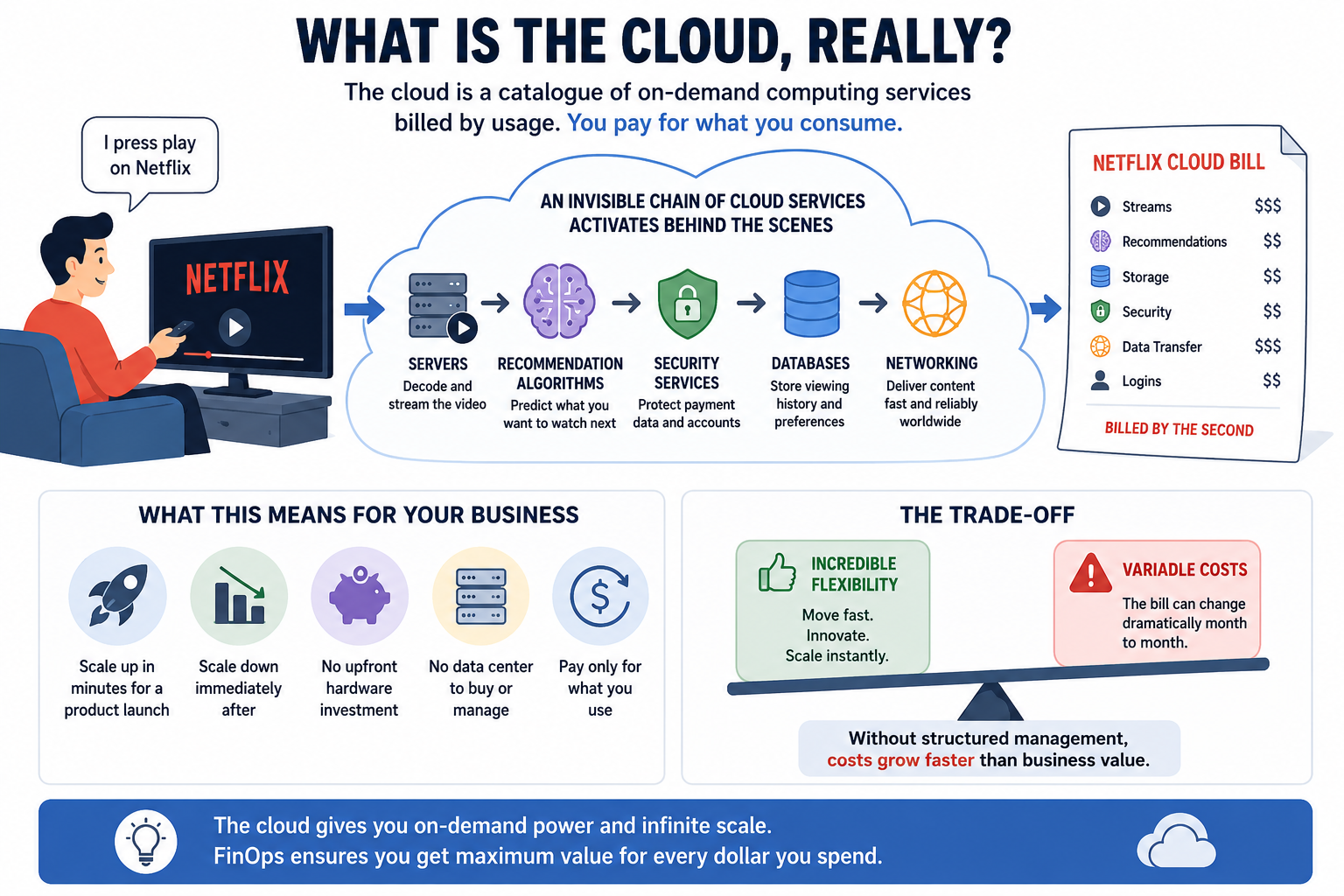
For a business, the cloud is a catalogue of on-demand computing services billed by usage. It includes virtual servers that run applications, databases that store and query business data, artificial intelligence services that process language and images, security tools, networking infrastructure, and yes, storage. The defining characteristic is the pricing model: you pay for what you consume, measured in hours, seconds, gigabytes, or API calls, with no upfront hardware investment.
A useful analogy is Netflix. When you press play on a series, an invisible chain of cloud services activates: servers decode and stream the video, recommendation algorithms predict what you want to watch next, security services protect your payment data, and databases store your viewing history. All of this runs on cloud infrastructure, billed to Netflix by the second. Netflix pays for every stream, every recommendation, every login attempt. That is exactly how enterprise cloud billing works, applied to your own business applications.
The flexibility of this model is genuinely powerful. Engineering teams can scale infrastructure up in minutes for a product launch and scale it back down immediately after. There is no capital expenditure, no hardware to depreciate, no data center to manage. But that same flexibility means the bill can change dramatically from one month to the next, and without structured management, costs grow faster than the business value they generate.
What Is FinOps?
FinOps is a contraction of Finance and Operations. It is the organizational practice of managing cloud spend as a shared responsibility between finance, engineering, and business teams, rather than treating it as a purely technical problem that IT handles invisibly.
Think of FinOps as the management accounting discipline applied to cloud infrastructure. Traditional management accounting gives business leaders visibility into where money is being spent, whether budgets are being met, and whether investment is generating returns. FinOps does the same thing for cloud infrastructure: it makes costs visible, attributable to specific teams and products, and connected to business outcomes.
Without FinOps, the typical pattern is reactive. A monthly cloud invoice arrives, someone spends several days trying to understand why it is higher than last month, and by the time the investigation is complete, another month of spend has accumulated. With FinOps, the same information is visible in real time, attributed to the right teams, and reviewed on a regular cadence that allows decisions to be made before problems compound.
A Real-World Scenario of how Finance enter FinOps
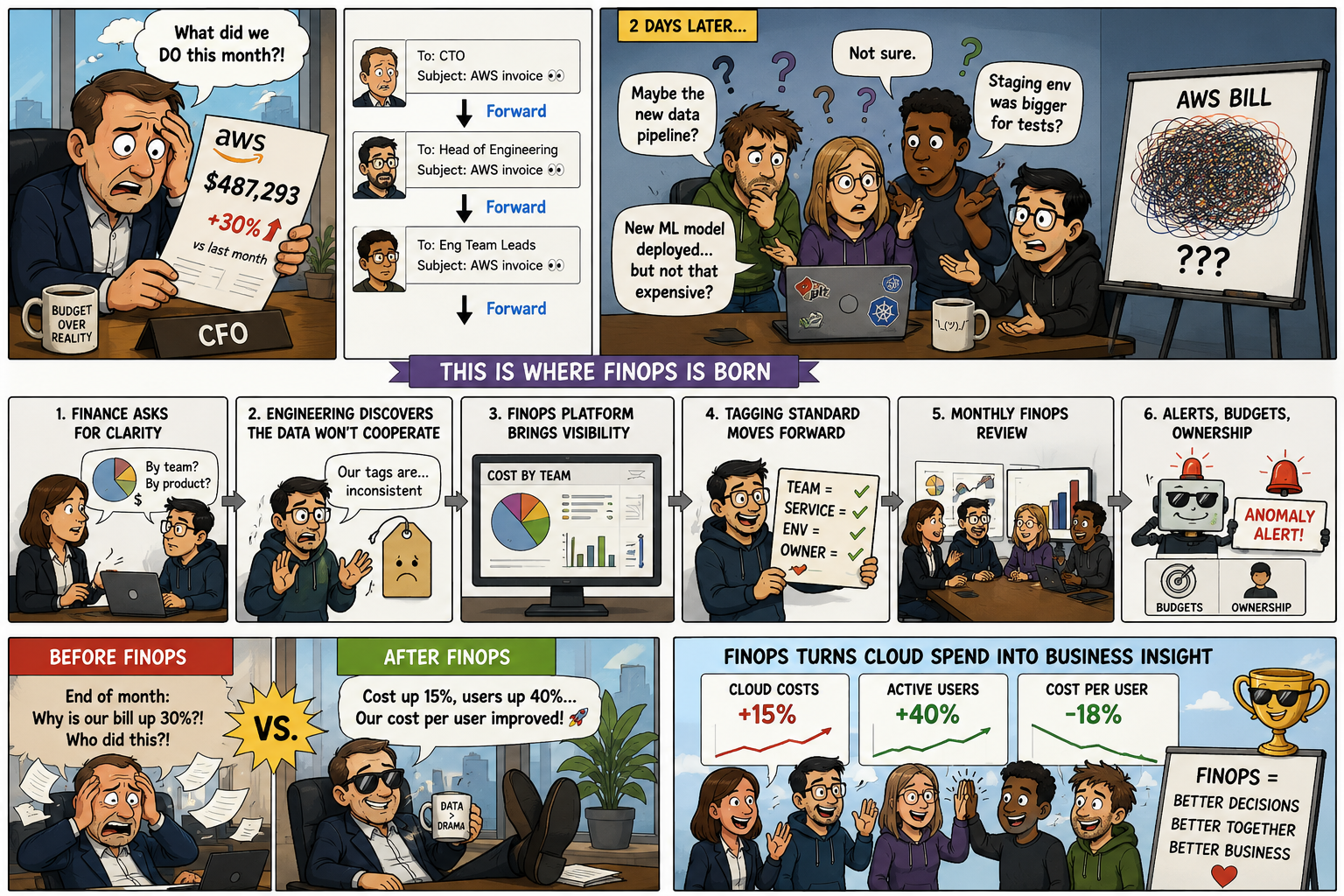
Picture a CFO of a 200-person SaaS company during month-end close. An AWS invoice arrives: cloud spend is up 30% month over month, with no clear product launch or customer growth to explain it.
The invoice is escalated from the CFO to the CTO, then to engineering. After days of investigation, the answer remains unclear. Possible causes include a new data pipeline, a scaled-up staging environment, or a recently deployed ML model—but nothing definitive.
The issue is not people, it is structure. Cloud invoices contain thousands of line items across services, accounts, and regions. Without proper tagging, cost allocation, and ownership, it is nearly impossible to trace spend back to a team or initiative in a timely way.
This kind of situation is common, and it is often the moment a FinOps practice begins.
The trigger is typically a cost spike, a budget overrun, or a realization that cloud spend has become one of the largest cost lines in the business. At that point, organizations shift from treating cloud bills as static invoices to managing them as active financial instruments.
What follows is a standard FinOps rollout: finance and engineering align on visibility, tagging standards are introduced, costs are allocated by team and product, and regular cost reviews are established. Budget targets and anomaly alerts bring real-time governance into place.
Within a few months, the conversation changes. Instead of asking why costs increased, teams start evaluating efficiency: how cloud spend relates to growth, users, and revenue. That shift from reactive cost analysis to business-aware cost management is the core value of FinOps.
Why FinOps Cannot Succeed Without Finance Buy-In
Many FinOps initiatives start in engineering. A DevOps or platform team notices cloud costs are rising too quickly, deploys monitoring tools, identifies waste, and sends optimization recommendations to teams. The technical analysis is often correct, yet six months later, the cloud bill has barely changed.
The reason is simple: without finance involvement, FinOps lacks budget authority and organizational accountability. Recommendations that are disconnected from budget targets remain optional. Engineers prioritize product delivery first, and cost optimization gets delayed indefinitely.
Finance transforms FinOps from a technical initiative into a business discipline. When cloud costs are tied to team budgets, reviewed during financial planning cycles, and reflected in showback or chargeback reporting, cost optimization becomes a measurable business objective rather than an engineering preference.
Finance also brings executive visibility. CFOs and finance leaders can escalate cloud cost governance to the leadership level where cross-functional decisions are actually made. This is what enables organization-wide standards for tagging, budgeting, commitment purchasing, and cost accountability.
The most effective FinOps programs are co-owned by finance and engineering from the beginning. Engineering provides the technical context and optimization actions, while finance provides governance, budget ownership, and financial discipline. FinOps succeeds when both teams work from the same cost data and align cloud spending with business objectives.
The Three Pillars of FinOps for Finance teams
The FinOps Foundation defines three core capabilities that every FinOps practice needs to develop. Understanding them helps finance and business leaders understand what they should be asking for from their engineering and FinOps teams.
Inform is the visibility layer. Before any cost can be optimized or governed, it needs to be visible. This means normalizing billing data from all cloud providers into a single view, attributing each cost to a specific team, product, or environment, and making that data available to everyone who needs it: finance, engineering, and business unit leaders. The inform capability answers the question: where is the money going, and who is responsible for it?
Optimize is the efficiency layer. Once costs are visible and attributed, the next step is finding and eliminating waste while maximizing the discount instruments available. Cloud providers offer significant discounts (typically 30 to 60%) in exchange for usage commitments. They also offer spot or preemptible pricing for workloads that can tolerate interruptions. And every cloud environment accumulates waste over time: idle servers, unused storage volumes, forgotten databases. The optimize capability answers the question: are we getting the best possible value from what we are spending?
Operate is the governance layer. Optimization is not a one-time project. Cloud environments grow continuously, new resources are provisioned daily, and costs drift without ongoing governance. The operate capability means having defined policies for how cloud resources are provisioned and tagged, regular cost reviews with clear accountability, budget alerts that fire before problems become crises, and a continuous improvement process that keeps the practice current as the environment evolves.
How Cloud Costs Are Structured
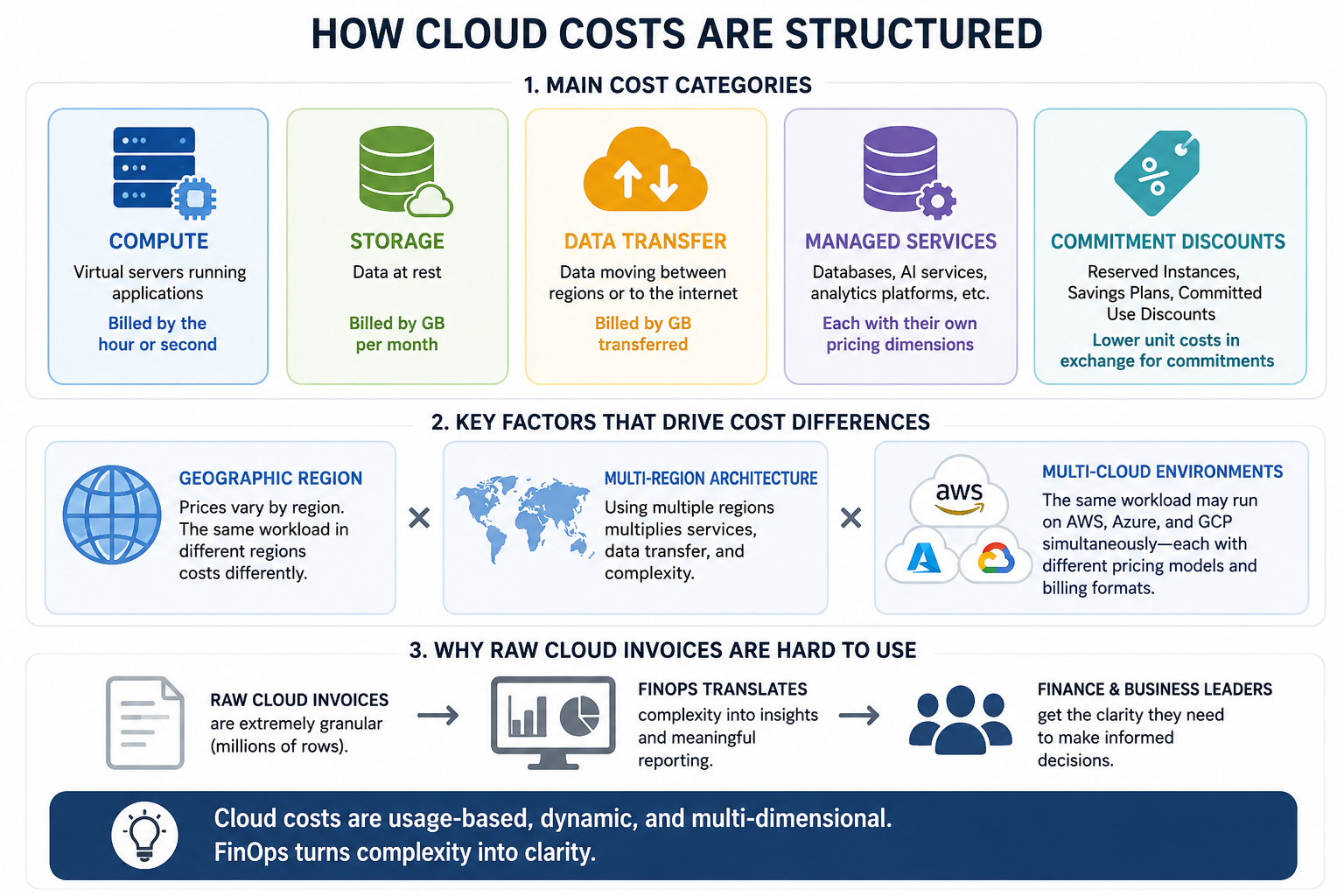
For a finance professional used to fixed or semi-fixed cost structures, cloud billing can be disorienting. There is no single line item. A cloud invoice is a granular, dynamic record of every service consumed, measured in units that vary by service type.
The main cost categories across AWS, Azure, and GCP are compute (virtual servers running applications, billed by the hour or second), storage (data at rest, billed by gigabyte per month), data transfer (data moving between regions or out to the internet, billed by gigabyte transferred), managed services (databases, AI services, analytics platforms, each with their own pricing dimensions), and commitment discounts (Reserved Instances, Savings Plans, Committed Use Discounts that reduce unit costs in exchange for usage commitments).
On top of these categories, costs vary by geographic region. Running a workload in AWS Ireland costs differently from running the same workload in AWS US East. Multi-region architectures multiply the complexity further. And in multi-cloud environments, the same type of workload may be running on AWS, Azure, and GCP simultaneously, each with different pricing models and different billing formats.
This is why raw cloud invoices are nearly impossible to interpret without tooling. A single AWS Cost and Usage Report can contain millions of rows. The FinOps function exists in part to translate this complexity into reporting that finance and business leaders can actually use.
Key FinOps Terms Every Finance Professional Should Know
Understanding a small set of technical terms makes it significantly easier to engage in FinOps conversations and read cost reports meaningfully.
On-demand pricing is the default cloud billing model: you pay for resources by the hour or second with no upfront commitment and no minimum usage. It is the equivalent of a pay-as-you-go mobile plan. On-demand is completely flexible but also the most expensive way to consume cloud resources. Organizations that run the majority of their stable, predictable workloads on on-demand pricing are consistently overpaying compared to what a commitment-based strategy would cost.
Commitment-based pricing is the alternative to on-demand: you agree to use a defined level of cloud resources for one or three years and receive a significant discount in exchange, typically between 30 and 60% depending on the provider, service, and term length. On AWS these instruments are called Reserved Instances and Savings Plans. On Azure they are called Reserved Instances and Azure Savings Plans. On GCP they are called Committed Use Discounts. The trade-off is reduced flexibility: if your usage drops below the committed level, you pay for unused capacity. Managing the right level of commitment across a cloud environment is one of the most financially impactful responsibilities in a FinOps program, which is why it sits naturally with finance teams rather than engineering teams.
Tagging is the practice of attaching metadata labels to cloud resources so they can be attributed to specific owners. A resource tagged with team:marketing and product:website can be included in the marketing team’s cost report and the website product’s unit economics. Without tags, cloud costs sit in an unattributed pool that nobody can act on.
Cost allocation is the process of distributing cloud costs to the right owners based on tags and other attribution rules. A mature cost allocation model attributes at least 85 to 90% of total cloud spend to a specific team, product, environment, or cost center, leaving minimal unallocated spend.
Showback and chargeback are two approaches to internal cost accountability. Showback means making cost data visible to teams without transferring financial responsibility. Chargeback means generating internal invoices that teams are actually charged against their departmental budgets. Both require high allocation accuracy to be credible.
Idle resources are cloud resources that are running and billing but not being used. A virtual server provisioned for a project that ended six months ago and never turned off. A database nobody queries. Storage volumes attached to nothing. Cloud waste studies consistently find that 25 to 35% of cloud spend falls into this category in organizations without active waste management.
Unit economics are the cloud cost metrics that connect infrastructure spend to business outcomes. Cost per active user, cost per transaction, cost per API call: these translate a technical cost into a business indicator that finance and product teams can interpret and act on. A doubling of cloud costs is alarming in isolation. The same doubling paired with a tripling of active users is a positive efficiency signal.
Egress fees are charges for data leaving a cloud provider’s network, either to the internet or to another cloud provider. These costs are frequently underestimated and can represent a significant fraction of total cloud spend in architectures that move large volumes of data between providers or serve large files directly to end users.
Rightsizing is the practice of adjusting cloud resource configurations to match actual workload requirements. An oversized virtual server that uses 10% of its CPU capacity is paying for 90% of performance that delivers no value. Rightsizing matches the resource to the actual need, reducing cost without impacting performance.
If you need to learn more FinOps vocabulary, here is a complete glossary.
How to Launch a FinOps Practice: A Business Leader’s Roadmap
For a CFO, finance director, or business unit head who wants to bring structure to cloud cost management, the following sequence of steps provides a practical starting point regardless of company size.
The first step is establishing visibility. Request a consolidated view of cloud spend broken down by team, product, and environment from your engineering leadership. If this information does not exist or takes more than a few days to produce, that is the first signal that a structured FinOps practice is needed. No optimization is possible without a reliable baseline.
The second step is deploying a FinOps platform. Native tools from AWS, Azure, and GCP provide basic visibility for their own services, but they cover only their own provider, require technical access that most finance stakeholders do not have, and lack the cost allocation and reporting features that make data actionable for business leaders. Third-party FinOps platforms like Holori aggregate data from multiple providers, apply cost allocation logic, and surface the reporting views that finance and business teams need alongside the technical views that engineering teams use. This shared visibility is what enables meaningful cross-functional cost conversations.
The third step is establishing ownership. Define which teams own which cloud costs, set clear budget targets by team or product, and establish a regular review cadence. Monthly for strategic review, weekly for operational monitoring. Anomaly alerts should notify the relevant team owner immediately when spend deviates unexpectedly, not three weeks later when the monthly invoice arrives.
The fourth step is framing costs as business metrics. The most powerful shift in a FinOps practice is moving from asking “how much are we spending on cloud” to asking “what are we getting for what we spend on cloud.” This requires defining unit economics: the cost metrics that connect infrastructure spend to business value. Once unit economics are defined and tracked, cloud cost decisions become business decisions rather than technical ones.
The fifth step is addressing waste and commitments. With visibility established and accountability in place, the FinOps team can identify and eliminate idle resources, rightsize overprovisioned infrastructure, and evaluate the commitment purchasing strategy. These optimizations typically generate savings of 20 to 40% in organizations that have not previously managed them systematically.
The Role of Finance in a FinOps Program
Finance teams bring capabilities to FinOps that engineering teams cannot replicate: budget management expertise, financial modeling, procurement experience, and the organizational authority to set cost governance policies that apply across the entire business.
Concretely, the finance contribution to FinOps includes defining the cost allocation model (which business units, products, and environments costs should be attributed to), setting and managing cloud budgets by team and product, owning the commitment purchasing strategy (Reserved Instances, Savings Plans, and enterprise discount negotiations with cloud providers), establishing showback and chargeback policies, and producing the financial reporting that translates cloud spend into terms that board-level stakeholders can interpret.
The engineering contribution is complementary: implementing the tagging required for allocation, acting on optimization recommendations, enforcing provisioning policies, and providing the technical context needed to interpret cost anomalies. Neither function can succeed without the other, which is why the FinOps operating model is explicitly cross-functional rather than assigned to a single team.
How Holori Supports FinOps for Finance Teams
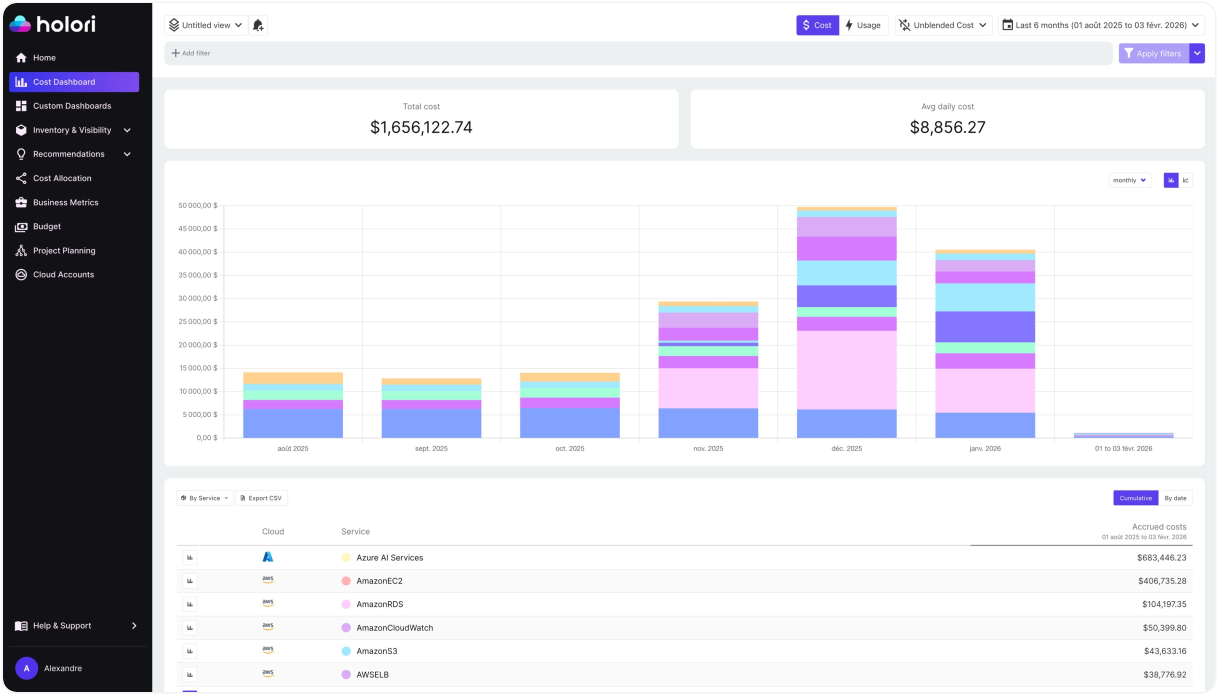
Holori is designed to serve both audiences simultaneously. Finance and business leaders get consolidated cost dashboards that show spend by team, product, and environment in reporting formats that map to budget structures rather than cloud provider taxonomies. Cost allocation, showback reports, budget tracking, and anomaly alerts are available without requiring access to cloud provider consoles or technical billing data. Virtual tags allow the finance team’s allocation model to be applied across all providers without requiring engineering teams to update resource tags retroactively.
Engineering teams get the technical layer they need: resource-level cost data, infrastructure diagrams showing what is running and how resources relate to each other, optimization recommendations, and the tagging compliance reporting that keeps allocation accurate.
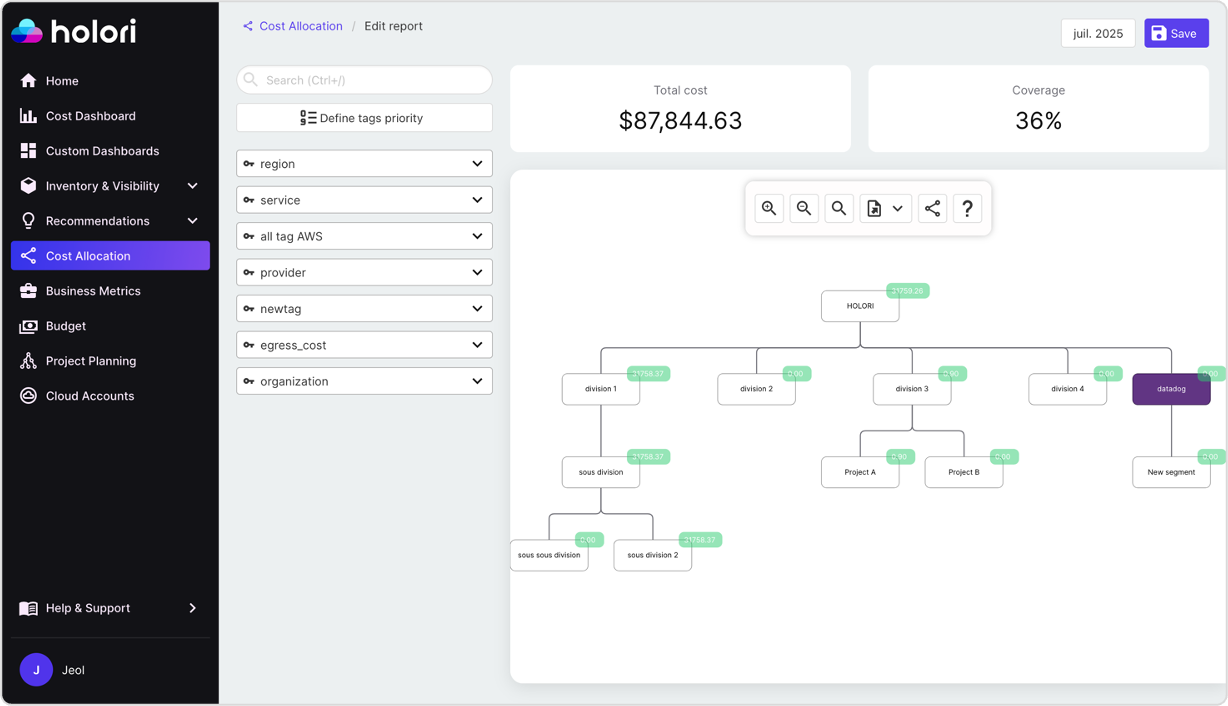
The shared platform means that when a finance review and an engineering review happen in the same week, both teams are looking at the same underlying data presented in the format appropriate for each audience. That shared data layer is what makes meaningful FinOps conversations between finance and engineering possible.
Try Holori now for free: https://app.holori.com/
Conclusion : Why FinOps for Finance Matters
Cloud cost management is not a technology problem. It is a coordination problem, and the organizations that solve it are the ones where finance and engineering have learned to speak the same language about infrastructure spend. FinOps is that language.
The CFO who understands what a Savings Plan is, the engineer who understands why cost allocation matters to the monthly close, the product manager who tracks cost per active user alongside revenue per active user: these are the people who make a FinOps practice work. The tools and processes matter, but the cultural shift is what sustains it.
The sooner finance teams engage with cloud costs as a first-class financial management responsibility rather than a technical invoice to be approved, the more control the entire organization gains over one of its fastest-growing and most complex cost categories. Start with visibility, establish ownership, connect spend to business outcomes, and the rest follows.