Most organizations do not build a FinOps team intentionally. They build one reactively. A cloud bill arrives that nobody can explain, a CFO asks engineering for a breakdown that takes three weeks to produce, or a quarterly cost review reveals that 30% of spend is untagged and unattributable. At that point, someone gets assigned to “sort out the cloud costs,” and a FinOps function is born, usually without a clear structure, defined roles, or a plan for scaling.
The reactive approach works until it does not. As cloud environments grow and span multiple providers, accounts, and teams, informal cost management breaks down. What was manageable with one person and a spreadsheet becomes a full-time problem requiring dedicated ownership, cross-functional collaboration, and proper tooling.
This guide covers how to build a FinOps team deliberately: which structure fits your organization, which roles to hire or assign first, how to get engineering and finance aligned from the start, and how the team evolves as the practice matures.
Why FinOps Requires a Dedicated Team
Cloud cost management is not a finance problem or an engineering problem. It is a coordination problem. Engineers make infrastructure decisions that drive costs. Finance owns the budget and needs visibility into spending. Leadership needs to understand whether cloud investment is delivering business value. Without a function that sits between all three, the same conversations happen every quarter without resolution.
Building a FinOps team is an incremental process for most organizations. The roles and skills required to foster a FinOps culture will evolve over time, but will typically require a mix of leadership, communication, analytical, and technical skills. What distinguishes a mature FinOps team from an informal cost review process is not headcount but structure: clear ownership of specific metrics, a defined cadence for reviews and decisions, and accountability that extends into engineering teams rather than sitting entirely in a central function.
Choosing a Team Structure Before Hiring Anyone
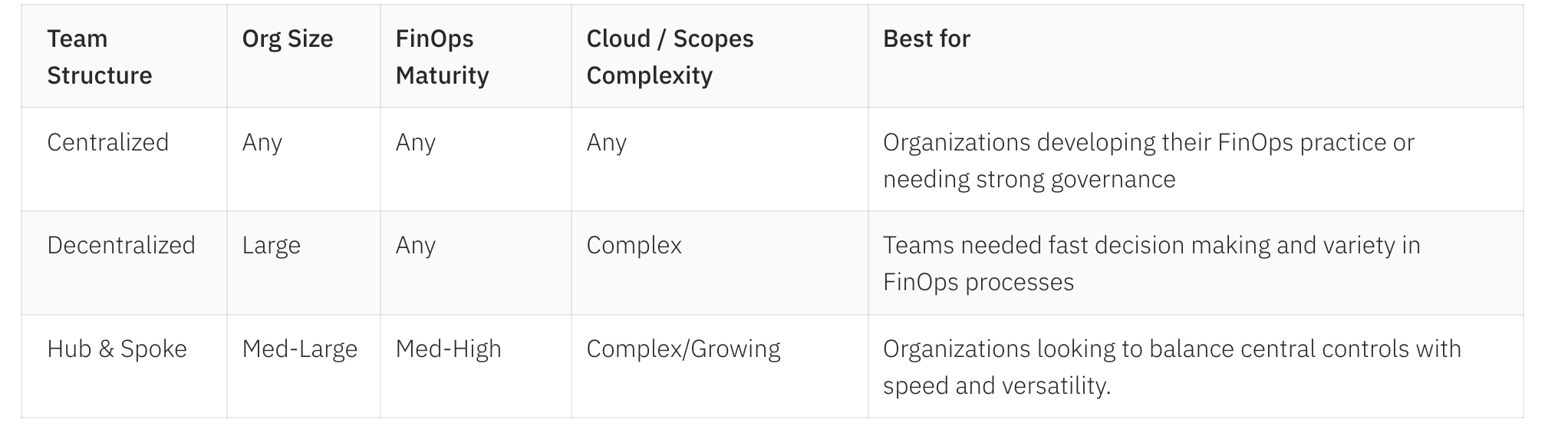
The first decision when building a FinOps team is not who to hire. It is how the function will be organized relative to the rest of the business. The right structure ranges from centralized (for strong governance and early adoption) to distributed (for fast local decision-making in large organizations) or a balanced hub-and-spoke model.
Centralized model places all FinOps responsibility in a single team that serves the entire organization. This team owns cost visibility, optimization recommendations, commitment purchasing, and reporting across all business units. It works well for organizations in the early stages of FinOps adoption, where the priority is establishing baseline visibility and governance before distributing responsibility. The risk is that a central team can become a bottleneck if it is too small to serve the entire organization, or can be perceived as a policing function rather than an enabling one.
Distributed model embeds cost accountability directly in individual engineering teams, product teams, or business units. Each team owns its own cloud budget, tracks its own metrics, and makes its own optimization decisions. This model works well in large organizations with mature engineering cultures where teams already operate autonomously. The risk is inconsistency: without a central function setting standards and tooling, tagging conventions diverge, reporting becomes fragmented, and organization-wide cost visibility breaks down.
Hub and spoke model combines both. A central FinOps team (the hub) sets standards, owns tooling, manages commitments, and produces organization-wide reporting. Embedded FinOps champions in individual teams (the spokes) apply those standards locally and surface cost feedback to the engineers making infrastructure decisions daily. This structure ensures clear accountability, streamlines decision-making, and facilitates collaboration between technical and financial stakeholders. For most mid-sized and large organizations, the hub and spoke model is the right long-term target.
For organizations just starting out, the centralized model with one or two dedicated people is the right place to begin. The hub and spoke model is something to grow into as the practice matures and engineering teams develop cost awareness.
The Core Roles to Fill to build a FinOps team
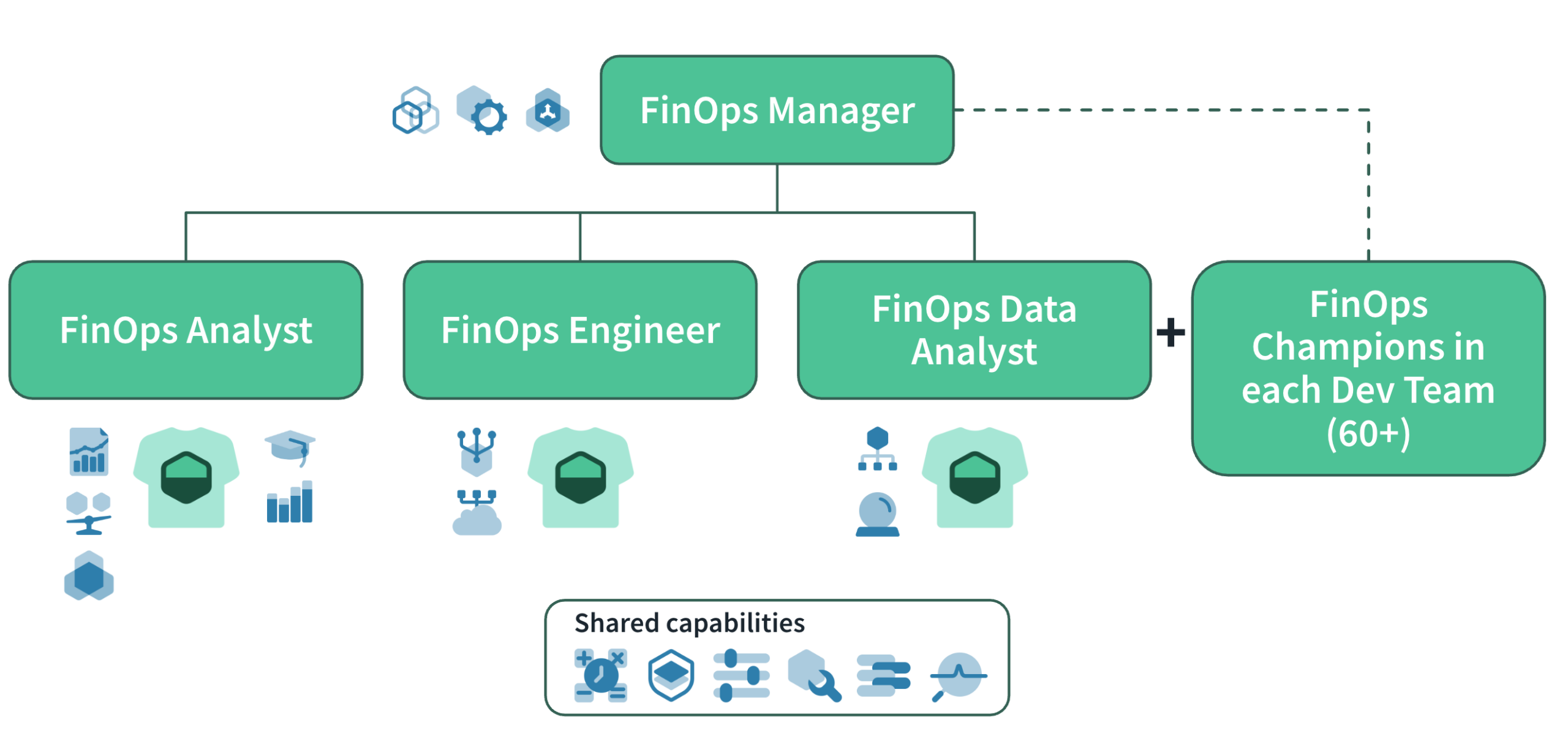
The four core FinOps roles are analyst, engineer, architect, and lead. In practice, smaller teams consolidate these into fewer people, and larger organizations add specialization. Here is what each role actually owns:
FinOps Manager is the function owner. This person is responsible for the overall FinOps strategy, executive reporting, cross-team alignment, and the operating cadence of the practice. They translate cost data into business language for leadership and translate business priorities into cost governance policies for engineering. The FinOps Manager acts as the connector between engineering, finance, and leadership. They run cost reviews, align spending with business priorities, introduce guardrails, and ensure the right tools and processes are in place. This is the first role to fill when building a FinOps team.
FinOps Analyst owns the data layer. They are responsible for cost allocation accuracy, tagging compliance monitoring, anomaly detection, budget variance analysis, and regular cost reporting. In most organizations this is a hybrid role requiring both financial literacy and enough technical understanding to work with cloud billing data, cost and usage reports, and FinOps tooling.
FinOps Engineer owns technical implementation. This includes building and maintaining tagging enforcement, automating lifecycle policies, implementing rightsizing recommendations, managing commitment purchasing workflows, and integrating cost visibility into CI/CD pipelines. This role sits closest to the engineering teams and is the primary driver of the shift-left mindset: embedding cost awareness into how infrastructure is designed and deployed, not just reviewed after the fact.
FinOps Champion is not always a dedicated hire. In the hub and spoke model, champions are engineers or team leads within product or platform teams who take on cost accountability for their domain alongside their primary responsibilities. They attend FinOps reviews, apply tagging and allocation standards to their team’s resources, and serve as the local point of contact for cost questions. Getting this role right is often the difference between a FinOps practice that changes engineering behavior and one that generates reports nobody acts on.
Executive Sponsor is essential and often overlooked as a structural requirement. The most successful FinOps transformations have executive sponsorship from day one. Leadership sets expectations around accountability and reinforces that cost efficiency is not about limiting innovation but about funding it sustainably. Without a sponsor at the CTO, CIO, or CFO level, FinOps recommendations get deprioritized whenever they conflict with engineering velocity or short-term business goals.
How to Staff the Team Based on Company Size
Team composition should be matched to the scale and complexity of the cloud environment, not to an org chart template.
For organizations spending up to around $1 million per year on cloud, there is rarely a dedicated FinOps hire and there does not need to be. At this stage, cloud cost ownership typically sits with the CTO, a Head of Platform, or a senior SRE who manages infrastructure costs as part of a broader remit. The priority is not building a function but establishing the basics: a tagging convention, a monthly cost review, and enough allocation visibility to know which services or teams are driving spend. A FinOps platform that surfaces this data clearly can make this a 2-hour-per-month responsibility rather than a full-time role. The goal at this stage is accurate data and one person who owns it, not a team.
For organizations in the $1 million to $10 million annual cloud spend range, a dedicated lead plus one analyst and one engineer is the right starting point. The lead owns stakeholder communication and strategy. The analyst owns reporting and allocation accuracy. The engineer begins implementing automation and managing commitments. FinOps champions should be identified in the two or three largest engineering teams.
For organizations above $10 million in annual cloud spend, the team needs to scale accordingly. At this level, the cost of suboptimal commitment management, undetected waste, or poor allocation accuracy is significant enough to justify dedicated specialization. Multiple analysts covering different providers or business units, a dedicated engineer for automation and tooling, and a formal champion network across all major engineering teams become necessary rather than optional.
Getting Engineering Buy-In: The Hardest Part
The structural and staffing decisions are straightforward compared to the cultural challenge: getting engineering teams to treat cost as a first-class concern alongside performance, reliability, and velocity.
The most effective approach is to make cost data visible to engineers in the context they already work in, rather than in a separate finance dashboard they never open. Cost attribution at the team or service level, surfaced in the same tools engineers use for monitoring and observability, creates awareness without adding friction. When an engineer can see that their service costs $4,200 per month and that a rightsizing recommendation would reduce it by $800, cost optimization becomes a concrete engineering task rather than an abstract finance concern.
Framing matters as well. FinOps programs that position themselves as cost police generate resistance. Programs that position themselves as efficiency advocates, helping teams do more with the same budget, generate collaboration. The metrics shared with engineering teams should reflect efficiency (cost per request, waste rate, utilization) rather than raw spend, which engineers often have limited ability to influence directly.
Where FinOps Sits in the Org Chart
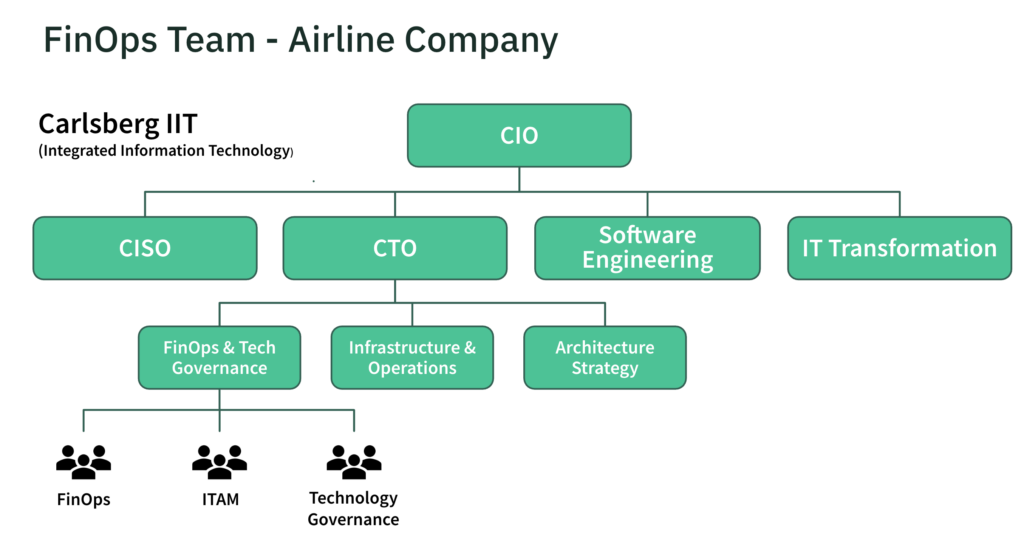
The reporting line question is one of the most debated decisions when formalizing a FinOps function, and there is no universal right answer. Where FinOps reports has real implications for how the team is perceived, which stakeholders it has natural access to, and which problems it is best positioned to solve.
FinOps teams tend to report to the executive who is responsible for making technology selections and use successful. In organizations where the focus is on digital transformation, the CTO or CIO tends to be in charge of FinOps as well as technology decision making more generally.
In practice, the reporting line tends to follow the primary driver of the FinOps initiative. When FinOps starts as a response to runaway cloud costs flagged by finance, it often lands under the CFO or a VP of Finance. This gives the team strong budget authority and direct access to financial planning cycles, but can make it harder to influence engineering decisions if the team is perceived as a cost control function rather than a technical one.
When FinOps starts as an engineering initiative driven by a CTO or Head of Platform who wants better infrastructure efficiency, it typically sits under technology. This gives the team natural credibility with engineering teams and easier access to the people who make infrastructure decisions daily, but can reduce its influence on financial planning and procurement.
The hub and spoke model described earlier tends to work best when the central FinOps function reports to technology, with a strong dotted line to finance. This positions the team as an engineering enablement function with financial accountability, which is the combination that generates the most cross-functional traction. Regardless of the reporting line, what matters most is that the executive sponsor has genuine authority over both cloud spending decisions and the engineering teams that drive them.
FinOps Certification: Is It Worth It?
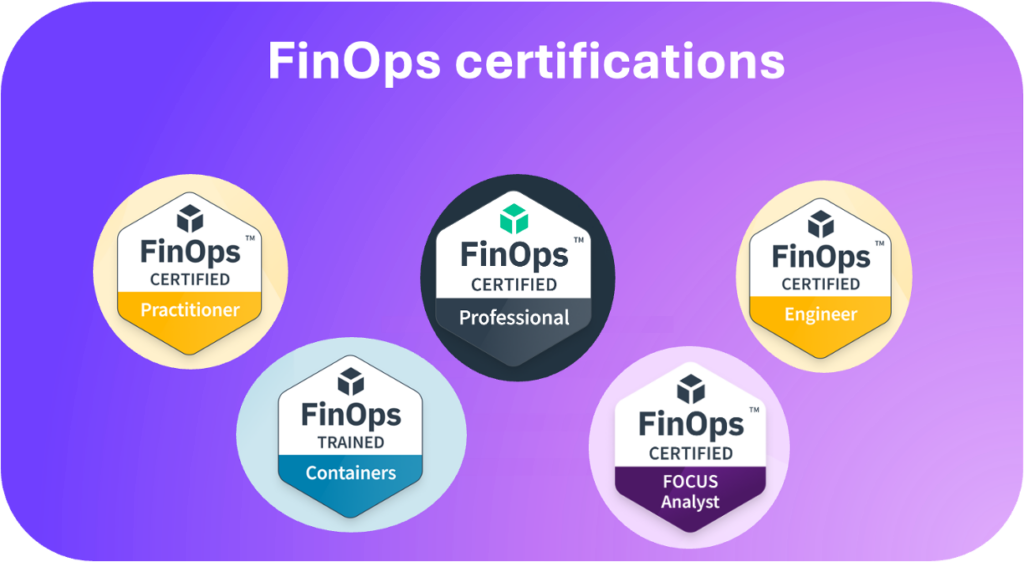
As the FinOps function professionalizes, certification has become a meaningful signal when hiring or developing FinOps talent. The FinOps Foundation offers the primary certification track in the industry, with two main levels.
The FinOps Certified Practitioner (FOCP) is the entry-level certification covering FinOps principles, the crawl-walk-run maturity model, personas, and core capabilities. It is well suited for analysts, engineers, or SREs taking on FinOps responsibilities for the first time, and for engineering or finance stakeholders who need a shared vocabulary for cross-functional collaboration.
The FinOps Certified Professional (FOCP Pro) targets experienced practitioners leading FinOps programs, covering more advanced topics including operating model design, stakeholder management, and capability maturity assessment.
For organizations building a FinOps team, certification serves two practical purposes beyond the knowledge itself. It provides a common framework and vocabulary that makes onboarding new team members faster, and it signals to engineering and finance stakeholders that the FinOps function is operating from a recognized industry standard rather than an ad hoc internal methodology. For a CTO or Head of Platform picking up FinOps responsibilities alongside other work, the practitioner certification is a worthwhile investment of a few days that pays back in faster credibility with both finance and tooling vendors.
How the Team Evolves With Maturity
FinOps team structures evolve predictably as organizational maturity increases. In the crawl stage, organizations implement basic team structures with manual reporting, limited visibility, and reactive cost management. As organizations progress to the walk stage, team structures become more formalized with regular reporting cadence, established governance, and active cost optimization programs. At the run stage, FinOps team structures reach full capability with automated reporting, predictive analytics, and self-service capabilities.
The practical implication is that the team you build on day one is not the team you will need in two years. The initial focus is on visibility and allocation. The second phase shifts to optimization and commitment management. The third phase moves toward automation, unit economics, and embedding cost awareness into every engineering and product decision. Staff the team for where you are now, but design the structure for where you are going.
How Holori Supports Your FinOps Team
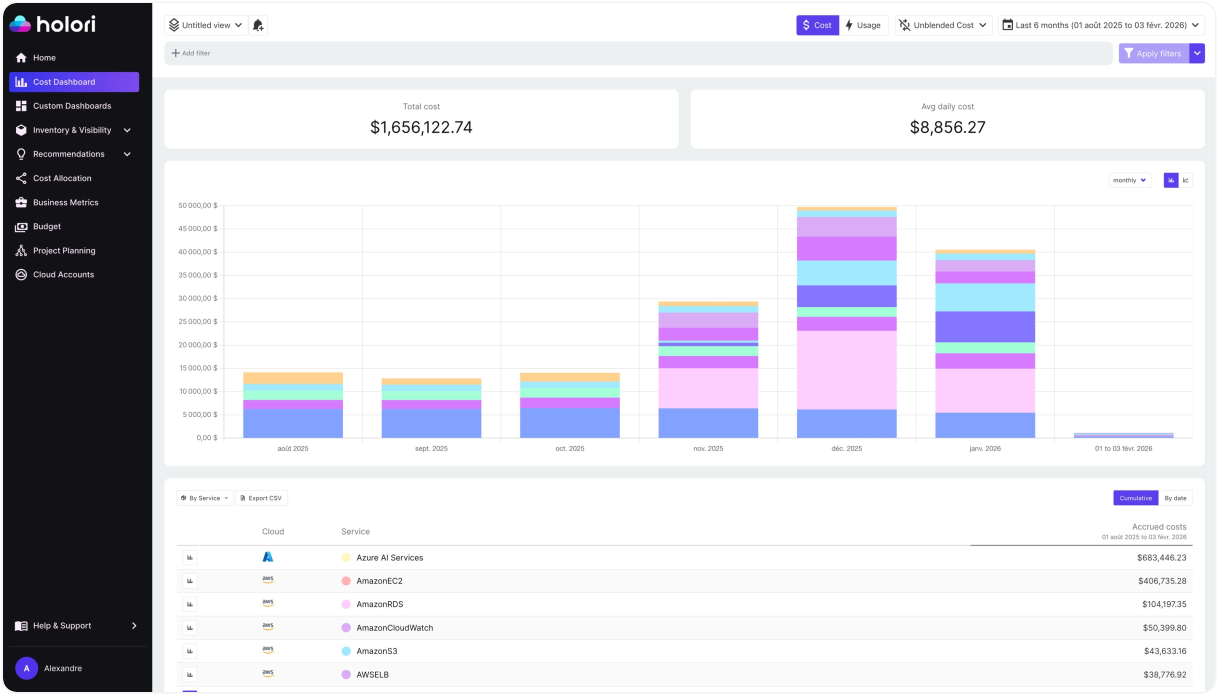
A FinOps team is only as effective as the data and tooling available to it. Holori gives FinOps teams a unified cost visibility platform across AWS, Azure, GCP and more which removes one of the most common early blockers: spending the first months of the practice just trying to reconcile billing data from multiple providers into a consistent format.
Cost allocation and virtual tagging give the FinOps analyst accurate attribution data from day one, even in environments where tagging compliance is still being established. Anomaly detection surfaces unexpected cost movements in real time, so the FinOps engineer can investigate and respond rather than discovering issues in monthly reviews. Infrastructure diagrams showing resource relationships, including attached and unattached disks, idle instances, and cross-account dependencies, give the team the visual layer needed to identify waste quickly without scripting custom queries against raw billing data.
For FinOps champions embedded in engineering teams, Holori’s team-level cost views provide the per-service and per-environment breakdown that makes cost conversations between the FinOps team and engineering concrete and actionable rather than abstract.
Building a FinOps team is not a one-time project. It is an ongoing investment in the organizational capability to make better decisions about cloud spending. The teams that get it right treat it that way from the start.
Try Holori for free now: https://app.holori.com/