Your cloud bill went up again. The question nobody in the room can answer is whether that is a problem.
That is the real failure of how most organizations track cloud costs. They monitor spend. They set budgets. They alert on overruns. But they never build the one capability that would let them answer the only question that actually matters: are we getting value for what we spend?
Cloud unit economics is how you answer that question. And in 2026, with AI workloads reshaping cost structures overnight, getting this right is no longer optional.
What Are Cloud Unit Economics?
Unit economics is the practice of measuring cloud costs relative to a meaningful business output. Instead of tracking raw spend, you track cost per unit of value delivered.
That unit depends entirely on your business. It could be cost per customer, cost per API call, cost per transaction, cost per gigabyte processed, or cost per active user. The point is to tie infrastructure spending to something the business actually cares about.
Without this lens, cloud cost data is nearly impossible to interpret. A $500,000 monthly AWS bill could be perfectly healthy for a company processing ten million daily transactions. It could be catastrophic for one processing a hundred thousand. Raw numbers tell you what you spent. Unit economics tells you whether you got value for it.
The core formula is: unit cost = total cloud spend ÷ volume. You divide your cloud spend by your chosen demand metric to get a cost per unit. That number, tracked over time, tells you whether your infrastructure is becoming more or less efficient as your business grows.
To implement it well, you need three types of data working together. Cloud cost data tells you where spend is going across services, teams, and products. Demand data shows how much your users are actually consuming, whether that is API calls, video streams, bookings, or something else specific to your business. Revenue data connects spend to what you are earning, so you can assess whether your cloud investment is generating a return or quietly eroding your margins.
A concrete example. Take a B2B SaaS company called Projectify that sells project management software. They spend $1.2M per month on cloud and process 8 million active workspace sessions per month. Their unit cost is:
$1,200,000 ÷ 8,000,000 = $0.15 per workspace session
Now look at what happens over six months as they grow:
| Month | Cloud spend | Workspace sessions | Cost per session |
|---|---|---|---|
| January | $1.20M | 8M | $0.150 |
| February | $1.24M | 8.9M | $0.139 |
| March | $1.29M | 10.1M | $0.128 |
| April | $1.35M | 11.6M | $0.116 |
| May | $1.42M | 13.4M | $0.106 |
| June | $1.50M | 15.5M | $0.097 |
Cloud spend increased 25% over the period. A traditional cost dashboard flags that as a concern. But unit cost dropped from $0.150 to $0.097, a 35% improvement. Demand is growing faster than spend, which means Projectify is scaling efficiently. The rising bill is not a problem. It is a sign the business is working.
Flip the scenario: if cloud spend rose 25% but sessions only grew 5%, unit cost would have jumped sharply. That is the signal that something is broken, and it is the signal you would completely miss without unit economics.
Why Raw Cloud Cost Metrics Are Not Enough
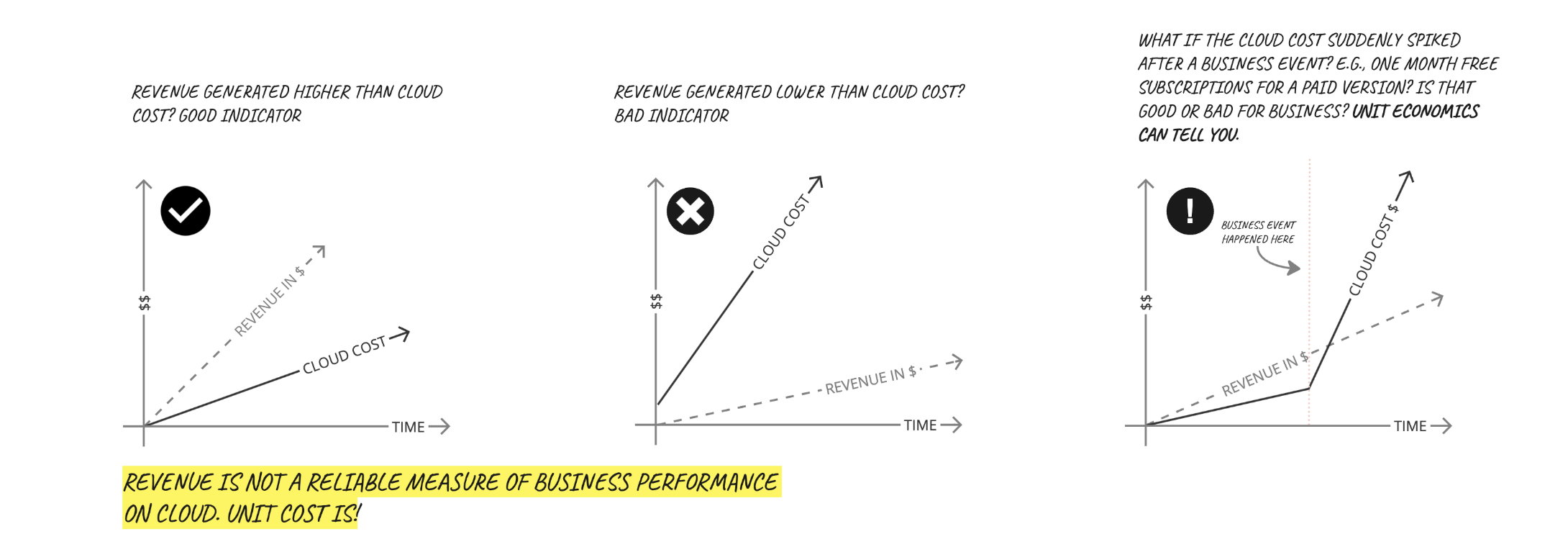
Traditional cloud cost monitoring focuses on budgets, variances, and service-level breakdowns. These are necessary but insufficient. They answer “are we over budget?” They do not answer “is our cost structure healthy relative to what we are building and selling?”
Consider a SaaS company that sees cloud costs rise 40% quarter over quarter. Is that a problem? It depends entirely on context. If revenue grew 80% over the same period, the cost increase is a sign of healthy scaling. If revenue grew 10%, the same number signals a structural issue that will compound over time. You cannot tell the difference without unit economics.
The same logic applies to infrastructure decisions. Migrating a workload to a cheaper instance type might reduce your monthly bill by $10,000. But if the migration increases latency and hurts conversion rates, the real business cost could be far higher. Unit economics gives you the framework to evaluate that tradeoff with precision rather than intuition.
How Cloud Unit Economics Transforms FinOps
The reason unit economics is foundational to FinOps is not just analytical. It is organizational.
Right now, Finance, Engineering, and Product all look at cloud costs through different lenses. Finance talks about budget variances. Engineering talks about CPU utilization and service-level drivers. Product talks about the cost of shipping a feature. These conversations consistently talk past each other because they measure different things.
Unit economics gives everyone the same language. It translates the esoteric line items of a cloud bill into units of business value that every stakeholder can reason about. Instead of debating whether a 12% cost increase is acceptable, teams can discuss whether the cost per transaction improved or worsened, and why. That is a conversation that leads somewhere.
The shift in practice looks like this. Vague questions like “why did our AWS bill spike?” become precise ones like “our cost per checkout increased 8% this month, here is which service is responsible.” Optimization efforts stop being arbitrary and start being tied to specific unit cost targets. Forecasts stop being based on last month’s spend and start being based on projected business volume.
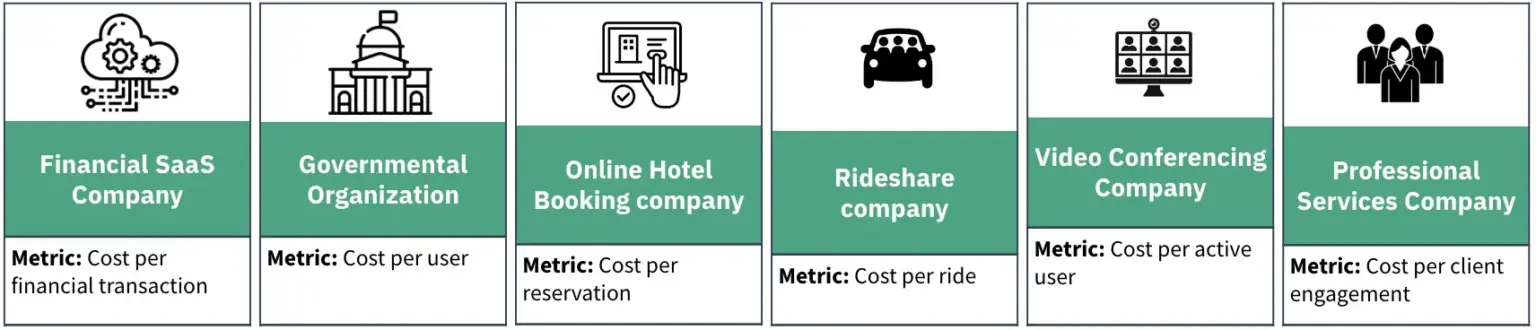
The metrics that anchor these conversations vary by business type, but they generally fall into three categories.
| Category | What it measures | Examples |
|---|---|---|
| Business | Commercial and customer activity | Cost per transaction, cost per acquired customer, cost per weekly active user |
| Financial | Service component value | Cost variance reduction, spend risk reduction, cost per million in revenue |
| Technical | Infrastructure efficiency | Cost per core hour, cost per GB of RAM, cost per API call |
Choosing the right unit is the single most important decision in this process. Pick one that scales linearly with your business activity and that engineers, product managers, and finance can all agree represents real value. Start narrow. You can always add more units as the practice matures.
How to implement Cloud Unit Economics
Getting unit economics off the ground requires three things done in the right order.
First, fix your cost allocation. Unit economics is only as accurate as your tagging strategy. If a significant portion of your cloud spend sits in untagged resources or shared cost buckets, your per-unit figures will be unreliable. Before investing in unit metrics, invest in tagging discipline. Tag by team, by product, by environment, and by customer tier wherever possible. This is unglamorous work, but it is the foundation everything else depends on.
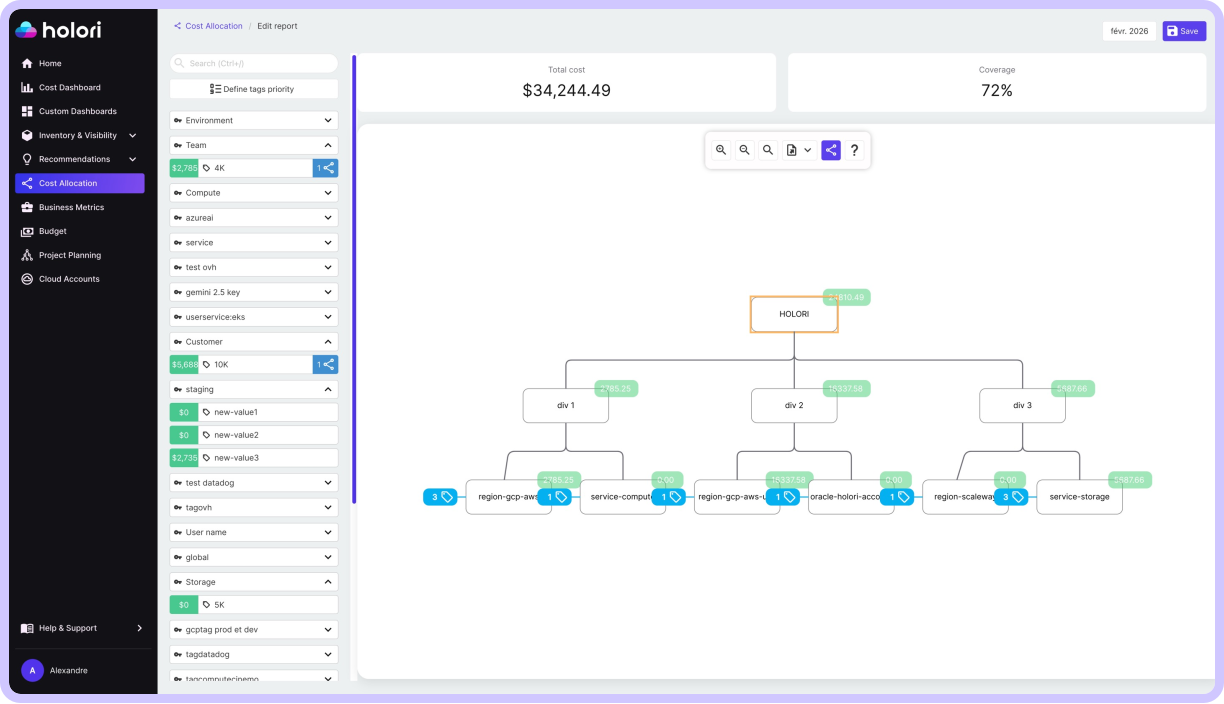
Second, define and instrument your units. Work with engineering teams to identify which cloud services contribute to each business outcome and how to measure them. Engineers have context that finance teams do not. The cost of processing a checkout, for example, might span compute, storage, a payment gateway, and a CDN. Getting that calculation right requires collaboration.
Third, set KPIs with real targets. A unit cost metric without a target is just a number. Once you have a baseline, use it to set concrete optimization goals. A team might commit to reducing their service’s unit cost by 20% over a quarter without degrading performance. Even if their total spend rises because traffic grows, a falling unit cost is proof that the team is running an efficient operation. That distinction matters enormously for how engineering work gets evaluated and prioritized.
Then measure consistently. A single snapshot is interesting. A six-month trend is where the real insight lives.
Forecasting and Pricing: The Two Use Cases Nobody Talks About Enough
Unit economics unlocks two capabilities that most organizations underuse.
On forecasting: the formula (total spend = unit cost × volume) means you can project future costs from business expectations rather than billing history. If transaction volume is expected to grow 50% next quarter and you have a roadmap to reduce unit cost by 15%, you can build a forecast that reflects both dynamics. That is fundamentally more accurate than trend-extrapolation, because it models the actual drivers of spend rather than assuming the past predicts the future.
On pricing: your unit cost sets the minimum viable price floor for every product and tier you offer. If you run a free tier, multiplying unit cost by the free allowance tells you exactly what each non-paying user costs to serve. If you have a premium tier you believe is highly profitable, unit economics will either confirm that belief or reveal that its costs are eating the margin you assumed. Either way, you make better decisions.
Why AI Makes All of This Urgent
AI workloads have introduced a cost variable that most existing FinOps practices are not equipped to handle.
The problem is volatility. A traditional web server has a relatively stable cost per request. An LLM inference call can range from fractions of a cent to several dollars depending on the model, the prompt length, the context window size, and the inference mode. A single product feature that calls a frontier model on every user interaction can add thousands of dollars per day to your cloud bill without triggering any traditional cost alert.
The companies getting surprised by AI costs are almost universally the ones tracking total AI spend but not cost per unit of AI output. Total spend tells you nothing about whether the feature is economically viable. It tells you even less about which part of the architecture is driving the cost.
This is exactly where unit economics applies. You pick the unit that best represents what your AI feature produces, measure the cloud cost behind it, and track it over time. The right unit depends on the use case.
- Cost per inference is the foundational metric for any AI workload. It captures the full cost of a single model call, including compute, API fees, and data transfer. If this number is rising unexpectedly, something in your usage pattern has changed.
- Cost per token matters for LLM workloads specifically, because token volume is the primary lever on cost. Tracking it over time surfaces prompt inefficiencies and context window bloat before they become expensive habits at scale.
- Cost per AI-assisted transaction is the metric that connects model usage to actual business value. If your AI feature costs $0.08 per interaction and demonstrably lifts conversion or retention, the economics work. If it is a convenience feature with no measurable return, that number will eventually become a hard conversation with finance.
- Model cost efficiency ratio compares the cost of a given model against the quality of its output for your specific use case. A smaller model delivering 90% of the quality of a frontier model at 20% of the cost is almost always the right choice for high-volume workloads. Without this metric, teams default to the most capable model available, regardless of whether the use case requires it.
AI also creates organizational accountability questions that unit economics helps resolve. When an AI feature spans engineering, product, and data science, who owns its cloud budget? Tying cost to the feature and the user journey rather than to the team structure gives a clean answer. That clarity becomes more important as AI spending grows.
See our article about AI cost allocation to have a comprehensive understanding.
How Holori Puts Unit Economics Into Practice
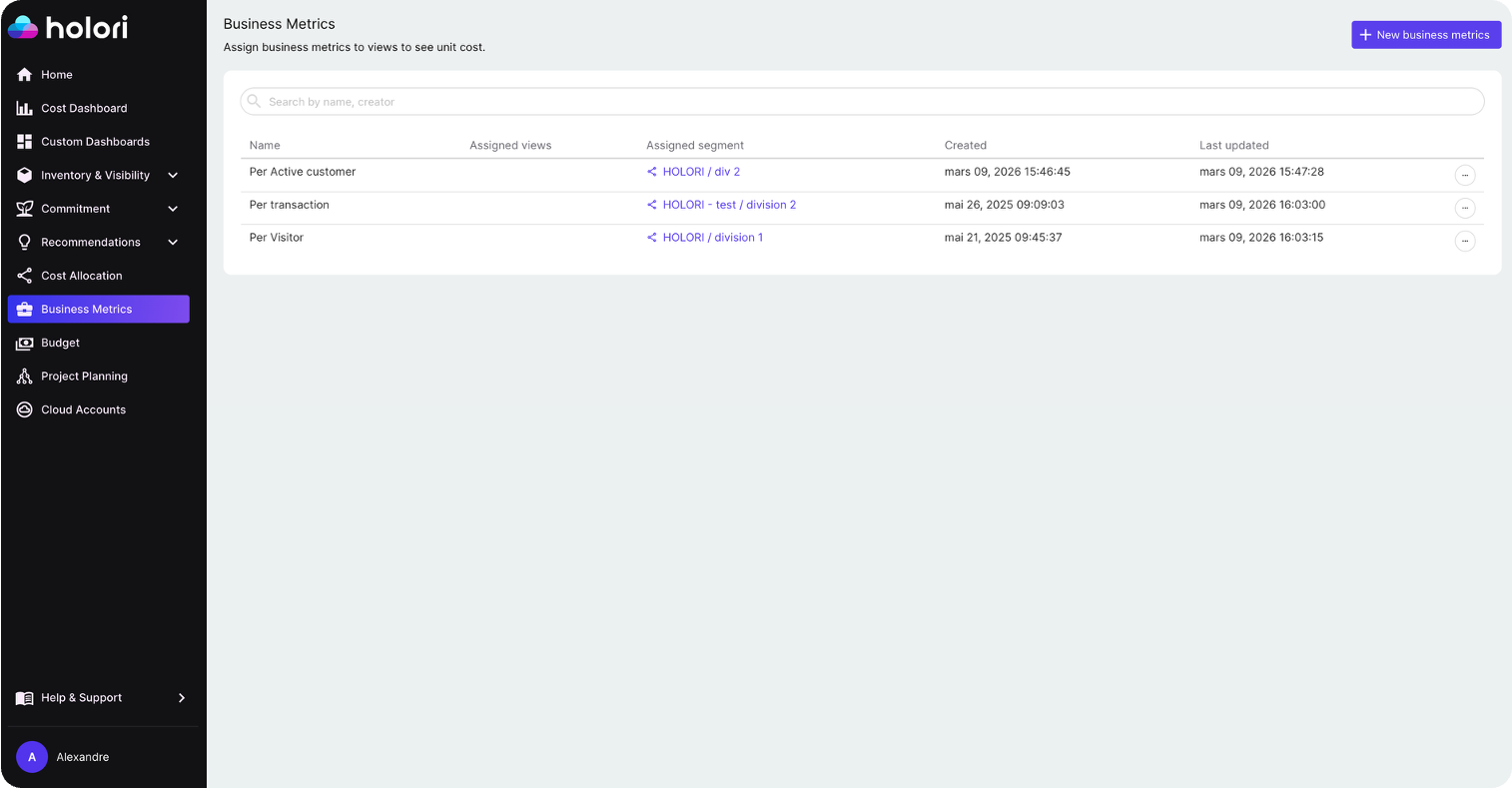
Understanding unit economics conceptually is the easy part. Implementing it across a multi-cloud environment, with inconsistent tagging, shared infrastructure, and AI costs spread across providers and APIs, is where most teams stall.
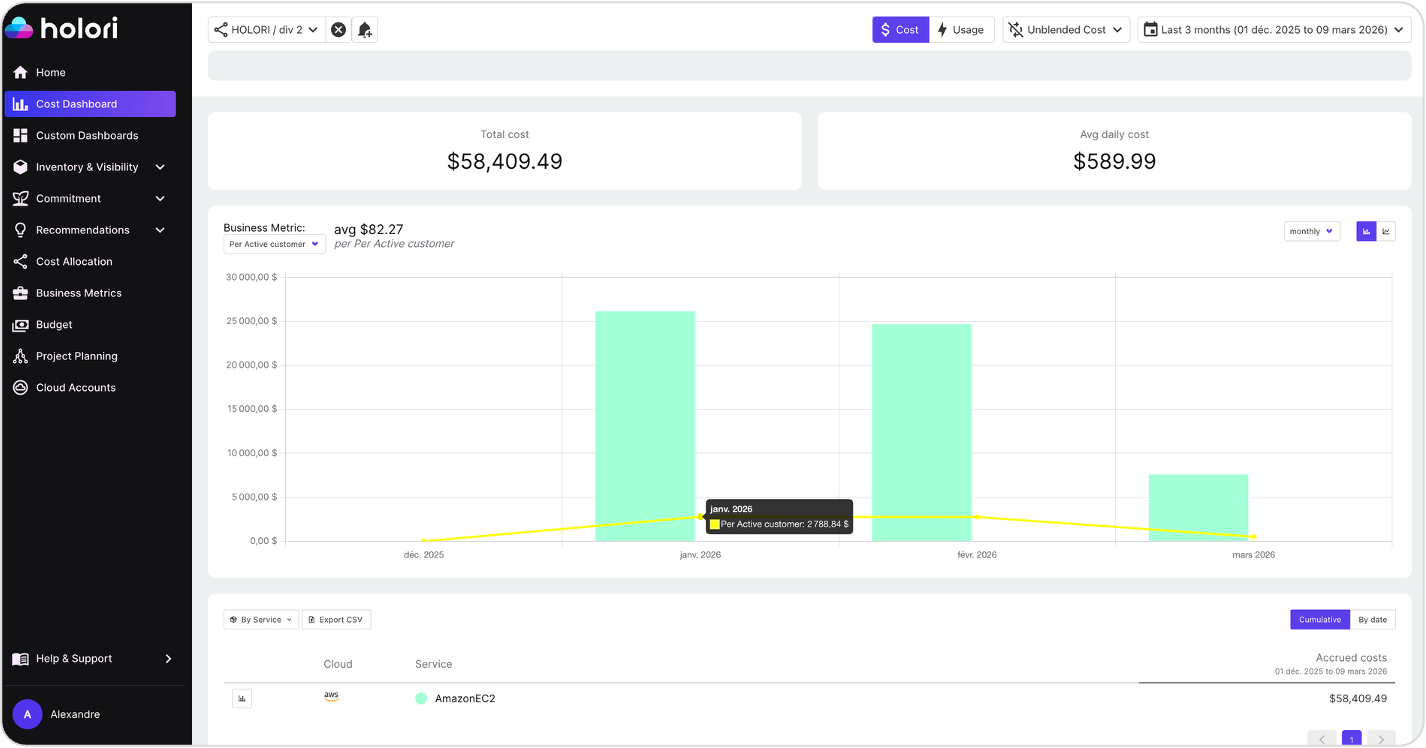
Holori’s unit economics feature is designed to close that gap. You define your units inside the platform, map them to your cloud resources across AWS, Azure, and GCP, and Holori handles the cost aggregation and trend visualization automatically. There is no custom scripting, no spreadsheet maintenance, and no manual reconciliation when costs shift.
The broader Holori platform connects unit economics to the rest of your FinOps workflow. Rightsizing recommendations, commitment coverage, tagging governance, and anomaly detection all sit alongside your unit cost dashboards. When a unit metric starts moving in the wrong direction, the tools to investigate and fix it are already in the same place.
Unit economics without action is just reporting. Holori is built to make it operational.
Conclusion: Cloud Unit Economics is the keystone of FinOps
The companies that will win on cloud efficiency over the next few years are not the ones that cut spend the most aggressively. They are the ones that understand what their spend produces and optimize accordingly.
Cloud unit economics is the practice that makes that possible. It replaces budget anxiety with business clarity. It gives every team a shared language for cost. And in an era where a single AI feature can reshape your entire infrastructure bill, it is the only framework that keeps cost conversations grounded in outcomes rather than noise.
If you do not know your cost per unit today, that is the first thing to fix. Everything else in your FinOps practice builds on top of it.
If you are ready to move beyond raw cost monitoring and finally answer whether your cloud spend is actually working, Holori gives you the unit economics visibility to know it with precision. Start your free trial today : https://app.holori.com/login
FAQ
What is cloud unit economics?
Cloud unit economics is the practice of measuring cloud costs relative to a specific business output. Instead of tracking total spend, you calculate how much it costs to produce one unit of value, such as one transaction, one active user, or one API call. The formula is: unit cost = total cloud spend ÷ volume. This gives you a metric that is comparable over time and meaningful to every team in the organization.
What is the difference between cloud unit economics and cloud cost management?
Cloud cost management focuses on monitoring, allocating, and reducing total cloud spend. Cloud unit economics goes one step further by connecting that spend to business outcomes. You can be excellent at cost management and still have no idea whether your infrastructure is efficient relative to what it produces. Unit economics answers that question. Both practices are necessary, but unit economics is what turns cost data into business insight.
How do you choose the right unit metric?
The right unit is one that scales directly with your core business activity and that every team can agree represents real value delivered. For an e-commerce platform it is typically cost per order. For a SaaS product it is often cost per active user or cost per tenant. For a data platform it might be cost per gigabyte processed. Start with one unit that reflects your primary value driver. Avoid units that are too broad, like cost per page view, or too narrow to be meaningful at the organizational level. You can add more units as your practice matures.
Why does cloud unit cost matter even when total spend is rising?
Because rising spend is not always a problem. If your unit cost is falling while total spend rises, it means demand is growing faster than your infrastructure costs, which is a sign of efficient scaling. If both total spend and unit cost are rising, that signals a structural inefficiency that needs investigation. Without tracking unit cost alongside total spend, you cannot tell these two situations apart.
What is the relationship between unit economics and FinOps?
Unit economics is one of the most powerful tools in the FinOps toolkit. FinOps is fundamentally about maximizing the value organizations get from cloud spending, and unit economics provides the measurement framework to do that. It gives Finance, Engineering, and Product teams a shared language for discussing cloud costs in terms of business outcomes rather than raw billing figures. Most mature FinOps practices treat unit cost metrics as primary KPIs, not secondary reporting metrics.