In 2026, managing cloud costs isn’t optional—it’s a strategic necessity for any tech-driven business. AI workloads, GPU instances, data pipelines, and multicloud architectures now represent a significant share of operational spend, yet few organizations can accurately explain where that money goes or why it increases month after month.
What makes the problem harder is not growth, but complexity. Pricing models vary by provider, services scale automatically, and AI usage introduces highly variable costs. As a result, unexpected overruns are common, accountability is fragmented between teams, and optimization efforts remain largely reactive.
The scale of the problem continues to expand. The global cloud computing market (including IaaS, PaaS, and SaaS) was valued at approximately $943 billion in 2025 and is expected to surpass $1 trillion in 2026, driven by AI adoption, enterprise modernization, and multicloud strategies
Despite this growth, industry data consistently shows that around 30–35% of cloud spending is wasted due to overprovisioning, idle resources, and insufficient financial governance. At the same time, accelerated compute—particularly GPUs and AI services—accounts for a growing share of total spend, significantly increasing cost volatility and financial risk.
This guide examines the 20 best FinOps tools of 2026, with a practical comparison of features, strengths, limitations, and pricing models, to help organizations regain visibility, improve accountability, and make cloud spending predictable again.
Core Capabilities of a Modern FinOps Platform
FinOps (Financial Operations) enables organizations to manage and optimize cloud costs with financial discipline. By combining cost visibility, governance, and best practices, FinOps ensures cloud spending is aligned with business objectives and delivers measurable value.FinOps (Financial Operations) is an essential framework for optimizing cloud spending. It integrates tools, policies, and best practices to monitor and manage cloud costs while aligning them with organizational goals. FinOps not only ensures cloud resources are used efficiently but also helps eliminate unnecessary expenses, turning cloud investments into a strategic asset.
Cost Visibility & Dashboards
Modern FinOps platforms provide intuitive, real-time dashboards that deliver comprehensive visibility into cloud spending across multiple providers. These dashboards help teams monitor usage, track trends, and make informed decisions.
Cost Allocation & Transparency
Effective FinOps tools enable accurate cost allocation across cloud providers, teams, projects, and even customers. This transparency ensures accountability and supports chargeback or showback models.
Cost Optimization Recommendations
FinOps platforms deliver actionable insights to reduce waste and optimize spending. These include recommendations for rightsizing resources, purchasing Reserved Instances or Savings Plans, and identifying underutilized or unused assets.
Budgeting & Financial Planning
With built-in budgeting, forecasting, and variance tracking, FinOps tools align financial planning with actual cloud consumption. Historical usage data supports more accurate predictions and proactive financial decision-making.
Anomaly Detection & Alerts
Real-time monitoring detects unusual spending patterns and triggers alerts before costs escalate. This proactive capability helps prevent unexpected spikes and budget overruns.
Top 20 best FinOps tools in 2026
The FinOps landscape is evolving quickly, with new tools constantly emerging, each offering innovative ways to optimize cloud costs. With so many options available, choosing the right solution for your needs can be overwhelming.
To help, we’ve compiled a list of the top 20 FinOps tools in 2025, including comprehensive platforms like Holori and specialized tools such as Kubernetes cost automation.
1- Holori
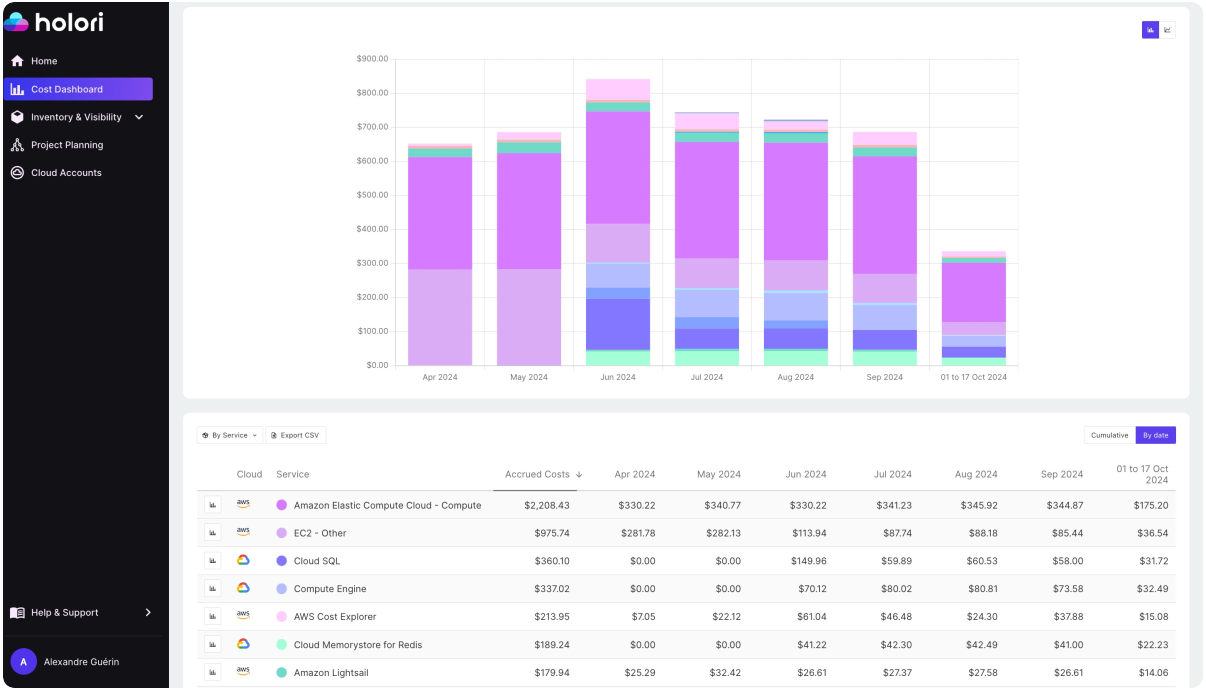
Holori is a leading cloud cost management and FinOps platform designed to give organizations full control over their cloud spending. Built for businesses of all sizes, Holori delivers deep cost visibility, actionable optimization insights, and robust cost governance across major cloud providers, including AWS, Azure, Google Cloud, and more. Its intuitive interface enables teams to optimize cloud investments without complex configurations.
One of Holori’s key differentiators is its FOCUS-native, security-first architecture. By supporting the FinOps Open Cost and Usage Specification (FOCUS), Holori delivers standardized, future-proof cloud cost reporting with seamless interoperability across providers and tools. At the same time, cloud cost data is never stored on Holori’s infrastructure and remains entirely on the customer’s side, ensuring maximum data security, compliance, and full ownership of financial and usage data.
With Virtual Tags and graphical cost allocation, Holori enables precise cost distribution across teams, projects, and cloud providers, strengthening financial accountability. In addition, the platform provides proactive cost-optimization recommendations to help organizations control budgets and prevent unexpected spending overruns.
At the core of the platform is Holori’s automated infrastructure diagram, which offers an interactive, visual representation of cloud resources. This unique capability allows teams to track infrastructure changes and asset configurations in real time, making the platform equally valuable for both FinOps and DevOps stakeholders.
Pricing
Holori offers a simple and transparent pricing model, typically around 1% of the customer’s total cloud spend.
2- Apptio Cloudability
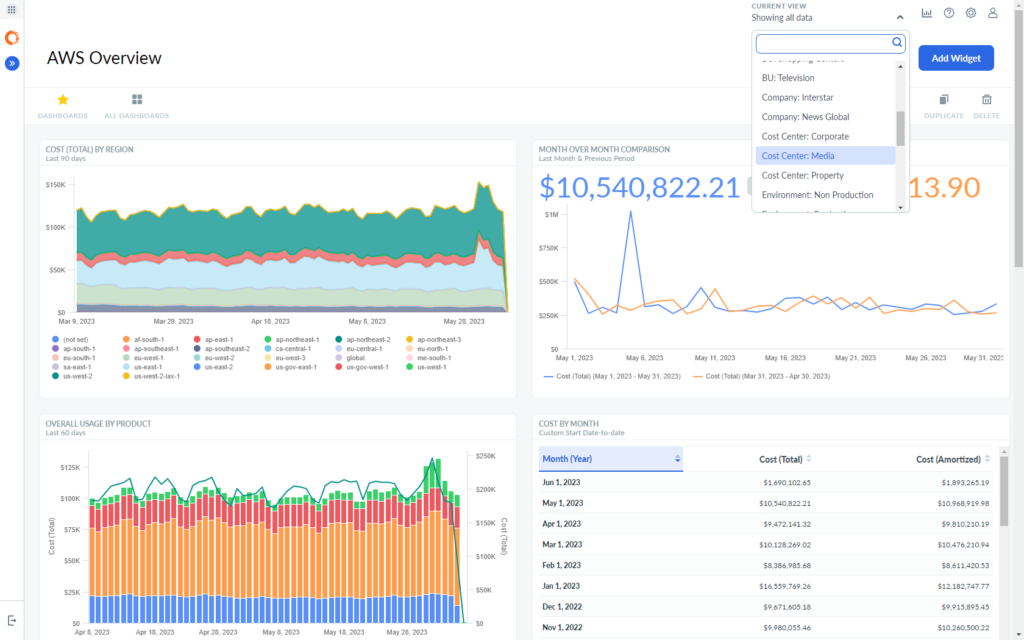
Apptio Cloudability, now part of IBM’s FinOps and cloud management portfolio, is a mature and comprehensive cloud financial management platform built to help large enterprises monitor, allocate, and optimize cloud costs across AWS, Azure, Google Cloud, Oracle Cloud Infrastructure, and third-party services.
Cloudability delivers deep multi-cloud cost visibility, advanced analytics, budgeting and forecasting, anomaly detection, and automated optimization recommendations. It supports detailed cost allocation with business mapping engines, flexible reporting, and customizable dashboards, enabling FinOps, finance, and engineering teams to gain shared insights and make more informed decisions.
Cloudability is especially well-suited for large organizations with complex FinOps requirements, offering scalability and enterprise governance capabilities that match high-volume, multi-cloud environments.
In addition to software, IBM and Apptio provide professional consulting and implementation services to help organizations embed FinOps practices and drive cultural change across teams.
Pricing
Cloudability typically uses a percentage-based pricing model tied to cloud spend — often around 2–3% of total cloud costs — though specific contract terms vary by organization and usage tier.
- Up to $1M of annual cloud spend: $30,000/year
- Up to $3M of annual cloud spend: $76 680/year
- Up to $9M of annual cloud spend: $132 480/year
3- Flexera
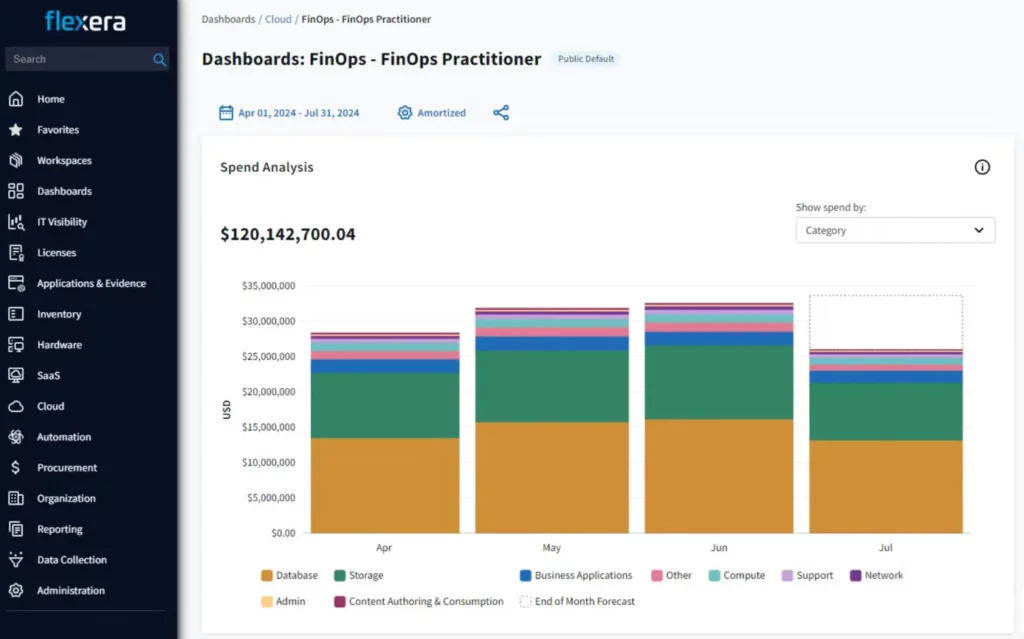
Flexera One is a comprehensive cloud financial management and FinOps platform designed for enterprises navigating complex multi-cloud, hybrid cloud, SaaS, and IT asset environments. It brings together FinOps, IT asset management (ITAM), and SaaS spend oversight into a unified platform, helping organizations understand and manage technology costs across both cloud and on-premises resources. This single pane of glass approach eliminates fragmented dashboards and provides clearer financial insights across the entire IT estate.
Flexera’s platform consolidates cost data from major cloud providers and combines it with related expenses like software licensing, support, and labor to offer holistic total cost of ownership (TCO) analysis and multi-cloud visibility. The solution supports cost allocation, budgeting, forecasting, anomaly detection, and governance — empowering teams to control spending, improve financial accountability, and drive optimization at scale.
A recent strategic expansion of Flexera’s FinOps capabilities came through its acquisition of Spot from NetApp in 2025, adding advanced technologies for cloud commitment management, Kubernetes cost optimization, spot instance automation, and container management to the platform. This broadens Flexera’s ability to help teams automate savings and optimize workloads across both traditional and cloud-native environments.
Pricing:
Pricing for Flexera One varies by deployment, scope, and contract terms. As an example from the AWS Marketplace, one tier lists approximately $200,000 for a 36-month contract covering up to 1,000 servers and 5,000 clients, though enterprise agreements are typically customized.
4- Cloudzero
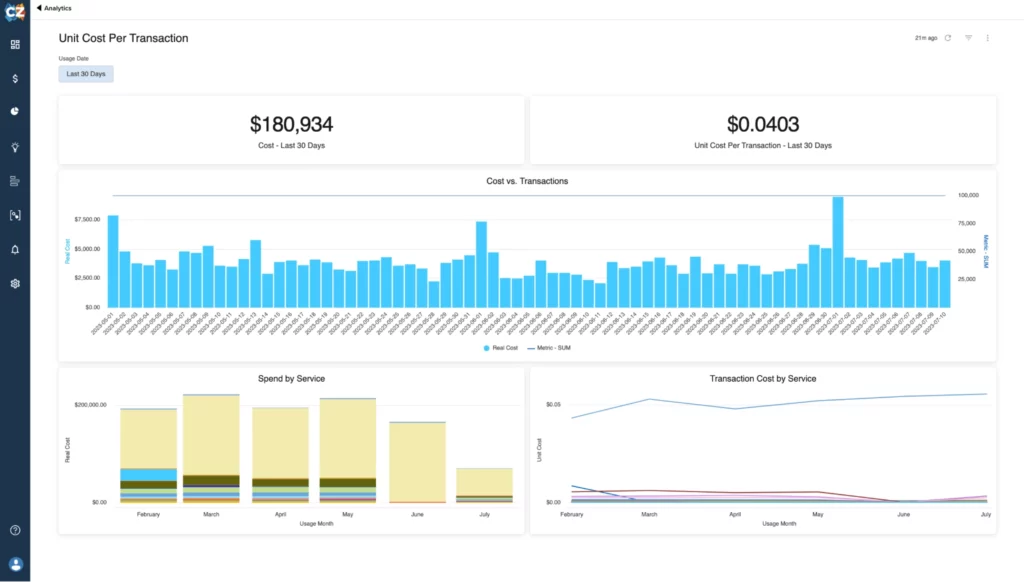
CloudZero is a modern FinOps and cloud cost intelligence platform designed to give organizations a proactive, business-driven approach to cloud cost management. Built with engineering-led teams in mind, CloudZero helps finance, engineering, and operations teams gain near real-time visibility into cloud spend while linking costs directly to what the business delivers. Rather than focusing solely on billing data, CloudZero provides a cost-based view of cloud usage that supports smarter decision-making without limiting the flexibility of cloud environments.
A key strength of CloudZero is its ability to map cloud costs to business objectives. The platform breaks down spending by team, service, feature, product, or customer, enabling organizations to understand exactly how resources are consumed and how costs align with value creation. Using enriched, contextualized cost data, CloudZero surfaces actionable insights, highlights optimization opportunities, and detects anomalies—empowering teams to reduce waste while maintaining performance, reliability, and developer velocity.
Designed to integrate seamlessly with cloud-native and Kubernetes-based environments, CloudZero is well suited for fast-growing, software-driven organizations that want a scalable FinOps solution. Its focus on unit economics, accountability, and engineering ownership helps move FinOps beyond traditional cost reporting toward continuous optimization and measurable business impact.
Pricing
According to the AWS marketplace, CloudZero follows a usage-based pricing model of approximately $19 per month for every $1,000 in cloud spend.
For example, an organization with $20,000 in monthly cloud costs would pay around $380 per month.
For larger cloud environments, custom pricing is available based on scale and requirements.
5- CloudHealth
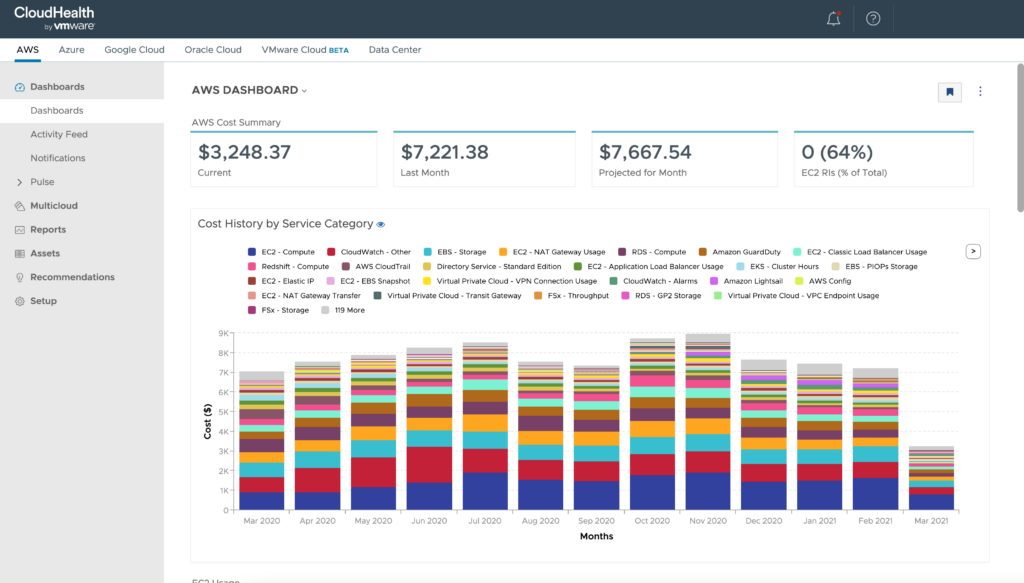
CloudHealth by VMware, now part of Broadcom’s Tanzu portfolio, is a mature, enterprise‑grade cloud financial management and FinOps platform designed to help organizations gain visibility, optimize spending, enforce governance, and align cloud costs with business priorities across multi‑cloud environments. It
CloudHealth combines detailed cost analytics, policy‑driven governance, automated budgeting, and advanced optimization recommendations, enabling FinOps, finance, and operations teams to track usage, allocate costs, implement savings strategies, and enforce guardrails at scale. The platform also supports rightsizing recommendations, commitment and savings plan planning, flexible budgeting and forecasting, chargeback/showback models, and anomaly detection, helping organizations better control and forecast cloud expenditure.
Recent investments in the product have introduced AI‑powered capabilities, such as the Intelligent Assist generative AI co‑pilot and Smart Summary dashboards, which help users interact with cloud data more intuitively, generate complex reports via natural language input, and quickly understand what cost changes occurred and why. These enhancements aim to make CloudHealth both more accessible to non‑technical stakeholders and more effective for seasoned FinOps practitioners.
Pricing:
According to their AWS marketplace prices, CloudHealth costs 3% of the cloud spend.
- Up to $150K of monthly AWS spend : $45 000/year
- Up to $300K of monthly AWS spend : $90 000/year
- Up to $500K of monthly AWS spend : $15 000/year
6- Datadog Cloud cost management
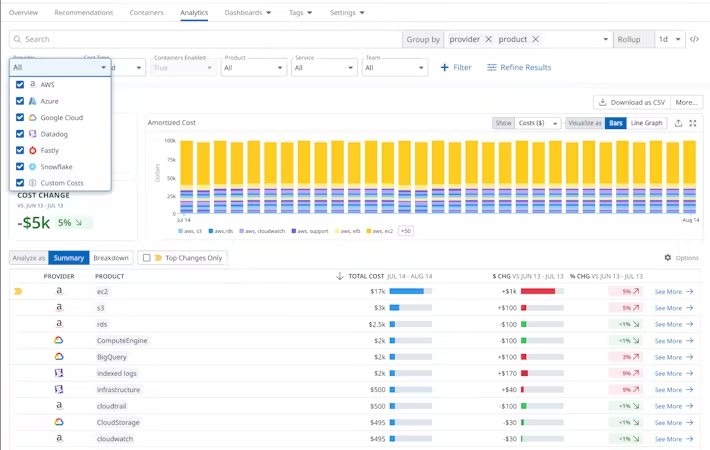
Datadog Cloud Cost Management is a cloud financial visibility and optimization solution built into the broader Datadog observability platform. It’s designed to help engineering, FinOps, and finance teams gain real‑time insight into cloud spending across AWS, Azure, and Google Cloud while tying those costs directly to application performance and operational metrics. This unified approach breaks down traditional barriers between cost and observability data, allowing teams to understand not just what costs are increasing — but why — in the context of system behavior.
By integrating natively with Datadog’s monitoring stack, Cloud Cost Management enables organizations to correlate financial and performance signals, surfacing cost drivers alongside metrics like CPU usage, request rates, or bottlenecks. This empowers teams to proactively explore and act on inefficiencies, such as underutilized resources, skyrocketing service costs, or waste in Kubernetes clusters — without leaving their primary workflow.
The platform offers automated anomaly detection, flexible budgeting and forecasting tools, and detailed cost attribution at the level of services, environments, teams, or custom business groupings. Granular spend allocation — including container and SaaS costs — helps drive accountability across the organization, while alerts and monitors notify teams of unexpected changes in cost patterns.
Pricing:
Datadog’s pricing for Cloud Cost Management is host‑based, meaning you pay a fee per monitored host per month as part of the Datadog platform. According to current Datadog pricing, Cloud Cost Management starts at approximately $7.50 per host/month (billed annually) or around $10.80 on demand.
7- Finout
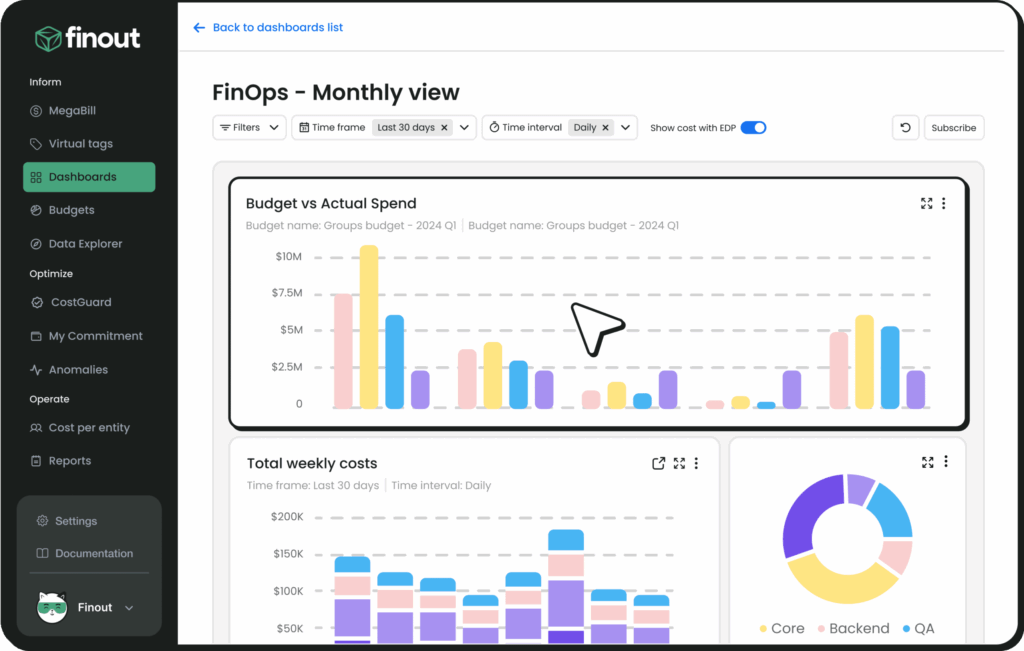
Finout is a comprehensive cloud cost management and FinOps platform built to help organizations manage multi‑cloud and SaaS spending at scale. It provides deep cost visibility, precise allocation, and automated financial planning across AWS, Azure, Google Cloud, Kubernetes, Snowflake, Datadog, and numerous other cloud services — all without requiring code changes, agents, or tagging prerequisites. This makes Finout especially attractive for teams seeking quick setup and reliable insights without heavy implementation overhead.
At the heart of the platform is MegaBill, Finout’s unified cost observability layer that consolidates all cloud and SaaS expenditures into a single, coherent cost model. This ensures organizations can see 100% of their spend in context and make decisions based on reliable data.
Finout also includes automated anomaly detection, budget alerts, and Virtual Tagging, allowing teams to assign business‑relevant labels in the platform even if those tags don’t exist upstream in cloud provider billing.
The platform is designed for both technical and financial stakeholders, making it easier to visualize spending by team, environment, service, or any custom dimension that matters to the business. This business‑centric view ties cloud cost to value delivery, helping organizations drive accountability and continuous optimization.
Pricing:
Need to request a quote.
8- Vantage
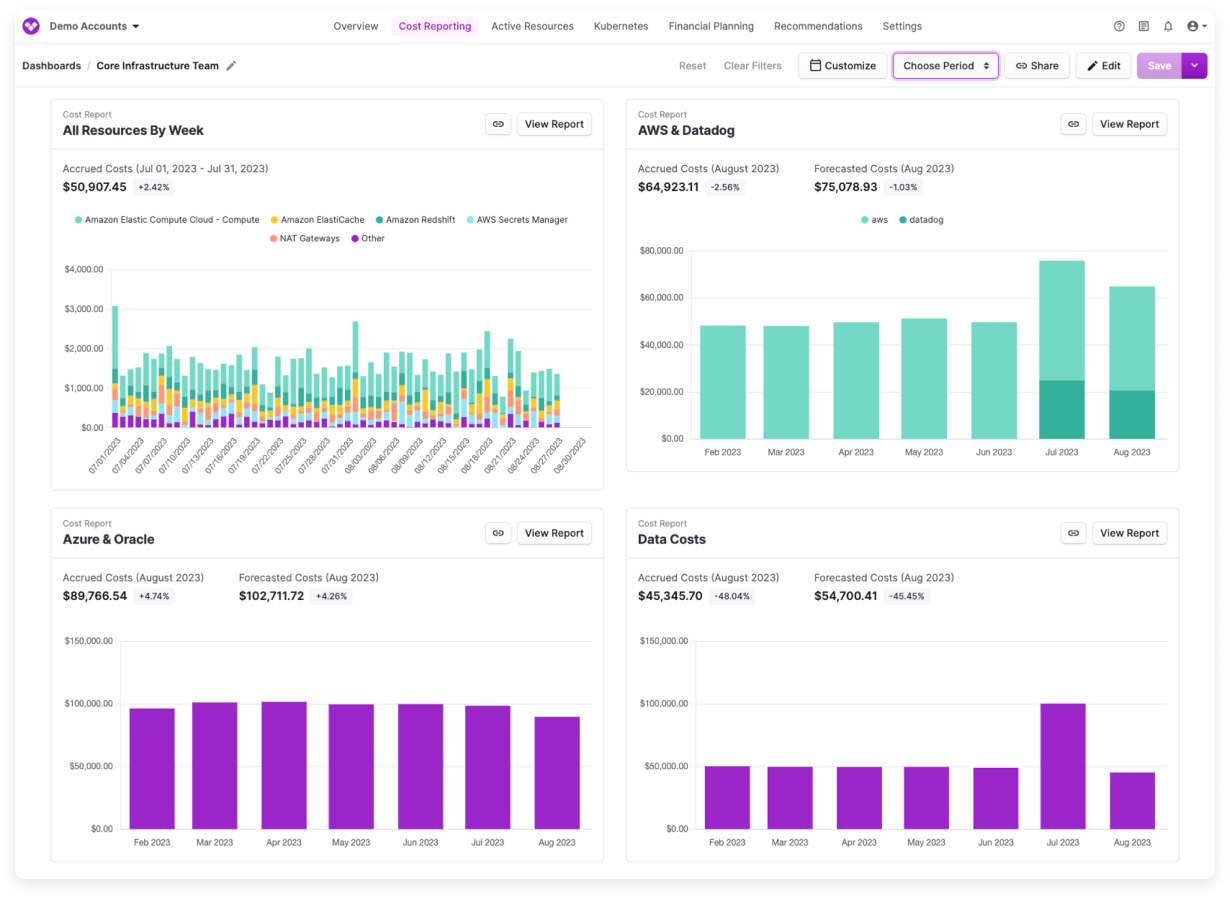
Vantage is a modern cloud cost management and FinOps platform built to help businesses monitor, analyze, and optimize cloud spending with simplicity and efficiency. Supporting major cloud providers including AWS, Azure, Google Cloud, as well as Kubernetes and a broad ecosystem of SaaS platforms, Vantage delivers a unified, easy‑to‑navigate dashboard that brings cost transparency and financial accountability to engineering, FinOps, and finance teams.
A standout strength of Vantage is its wide range of native integrations with third‑party services such as Datadog, Snowflake, Databricks, and others, enabling organizations to consolidate cost data from cloud infrastructure and SaaS services in one place. This breadth of integrations makes it particularly useful for teams managing diverse technology stacks and looking to centralize cost insights without complex setup.
Vantage emphasizes ease of use and rapid deployment, making it an attractive choice for startups, scaling businesses, and teams that want actionable cloud cost insights without heavy configuration or administrative burden.
Pricing
Vantage offers a tiered pricing model to meet different organizational needs:
- Starter (Free): For users with up to $2,500 of tracked costs, including essential features such as cost summaries, resource reports, and cost anomaly alerts
- Pro ($30/month): For up to $7,500 of tracked costs, with expanded capabilities
Business ($200/month): For up to $20,000 of tracked costs, suitable for growing teams
9-CAST AI – Automated Cost Optimization
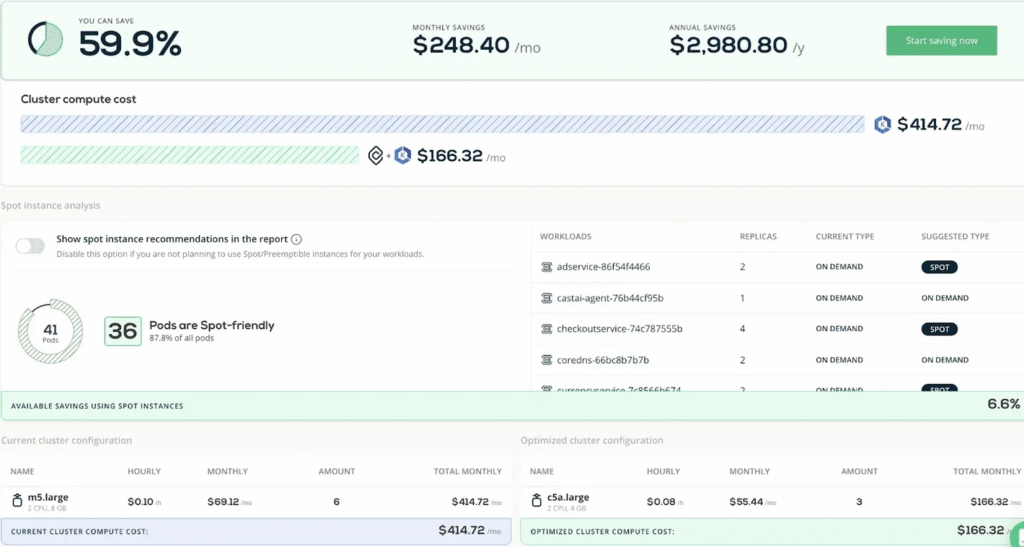
CAST AI is an AI‑driven cloud cost optimization platform specifically engineered to help organizations automate resource scaling and reduce cloud costs, with a strong emphasis on Kubernetes workloads across AWS, Google Cloud, and Azure. By combining real‑time automation, intelligent orchestration, and cost‑aware scheduling, CAST AI enables teams to optimize cloud infrastructure continuously—often delivering significant savings with minimal manual effort.
A defining strength of CAST AI is its AI‑powered automation layer, which makes Kubernetes cost optimization both proactive and autonomous. The platform continuously analyzes usage patterns and automatically right‑sizes, autosizes, and scales compute resources based on actual demand, eliminating idle capacity and overprovisioning. This real‑time autoscaling helps reduce cloud costs without sacrificing performance or reliability.
In addition to cost optimization, CAST AI is expanding its portfolio toward a more complete Kubernetes platform. Recent enhancements include global cluster management capabilities and the introduction of a Kubernetes security product, which brings runtime threat detection and configuration hardening into the same workflow used for cost optimization — a growing trend in cloud‑native infrastructure tooling.
Pricing
CAST AI offers flexible pricing tiers designed for different scales of Kubernetes usage:
- Free – $0/month: Includes Kubernetes cost monitoring, actionable optimization recommendations, and organization‑level cluster visibility.
- Growth – $200/month + $5/CPU: Covers up to 500 CPUs and 4 clusters, ideal for small to mid‑size environments.
- Growth PRO – $1,000/month + $5/CPU: Supports up to 2,000 CPUs and unlimited clusters, suited for larger deployments.
- Enterprise – Custom Pricing: Designed for enterprises with high scalability needs, offering unlimited scaling, enterprise SSO, and 24/7 support.
10- nOps: Automated FinOps for AWS Cost Optimization
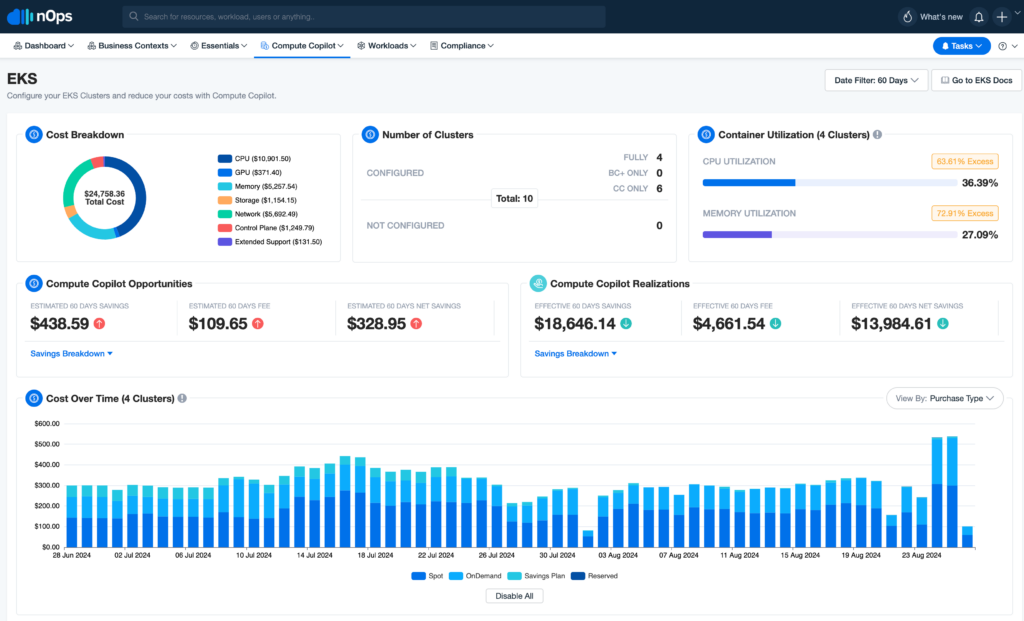
nOps is a FinOps‑certified, AWS‑native cloud cost optimization and governance platform designed to help organizations reduce waste, improve efficiency, and automate cloud financial operations. Built exclusively for AWS environments (with emerging support for Kubernetes cost optimization), nOps focuses on continuous, automated cost savings by providing real‑time recommendations and automated actions that drive measurable results.
The platform delivers automated cost analysis and optimization across key AWS services, helping teams eliminate idle resources, right‑size instances, and optimize their use of AWS Savings Plans and Reserved Instances. nOps continuously monitors usage and identifies cost‑saving opportunities without requiring extensive manual tagging or configuration, making it ideal for teams seeking automated, hands‑off FinOps workflows.
A standout capability of nOps is its Spot Instance orchestration and workload scheduling, which dynamically detects opportunities to replace costly On‑Demand instances with lower‑cost Spot Instances while maintaining performance and availability. Combined with automated rightsizing, auto‑scaling guidance, and ongoing Savings Plan
Pricing
nOps uses a performance‑based pricing model tied to the savings it delivers. You pay a percentage of the actual cost savings achieved through the platform’s optimization actions, aligning cost with value and ensuring you only pay for measurable results.
11- DoiT Cloud Intelligence
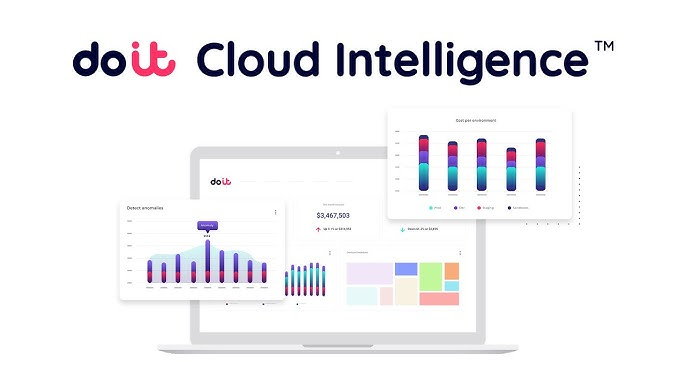
DoiT Cloud Intelligence is an advanced FinOps and cloud management platform that helps organizations monitor, optimize, and govern cloud costs across multi‑cloud environments — including AWS, Google Cloud, and Azure — while aligning spending with business objectives. It goes beyond traditional cost dashboards by combining AI‑driven insights, automation, and expert guidance to turn cost visibility into actionable outcomes.
At its core, DoiT’s platform delivers deep cost analytics, anomaly detection, automated recommendations, and advanced cost allocation, enabling FinOps, engineering, and finance teams to understand where cloud spending is going, why it’s happening, and how to optimize it effectively. The solution ingests billing and usage data from cloud providers as well as third‑party services — such as Snowflake, Datadog, and other SaaS/PaaS systems — and normalizes it into a unified dataset for comprehensive cloud and SaaS cost management.
Pricing
Exact pricing requires contacting DoiT directly for a tailored quote.
12-Pointfive
PointFive is a next‑generation cloud cost and efficiency platform built to help engineering and FinOps teams continuously identify, contextualize, and remediate cloud inefficiencies across multi‑cloud environments. Rather than acting as a passive cost dashboard, PointFive’s solution is designed to embed cloud efficiency into engineering workflows and drive measurable savings by surfacing actionable insights tied directly to technical context.
At the core of the platform is Cloud Efficiency Posture Management (CEPM) — a proactive discipline that continuously monitors, analyzes, and improves cloud efficiency instead of relying on periodic reviews. PointFive’s DeepWaste™ Detection engine uses sophisticated algorithms to uncover hidden inefficiencies that traditional tools often miss, including misconfigurations, long‑tail waste, and underutilized resources — even in complex multi‑cloud stacks like AWS, GCP, and Kubernetes. These insights are enriched with usage patterns, resource relationships, and organizational context so teams understand not just what is inefficient, but why and how to fix it.
Pricing:
According to the AWS Marketplace:
Business: $70.5K/year — up to $3M annual cloud spend
Scale: $140K/year — up to $7M annual cloud spend
13- Attribute (Attrb / Attribute.io)
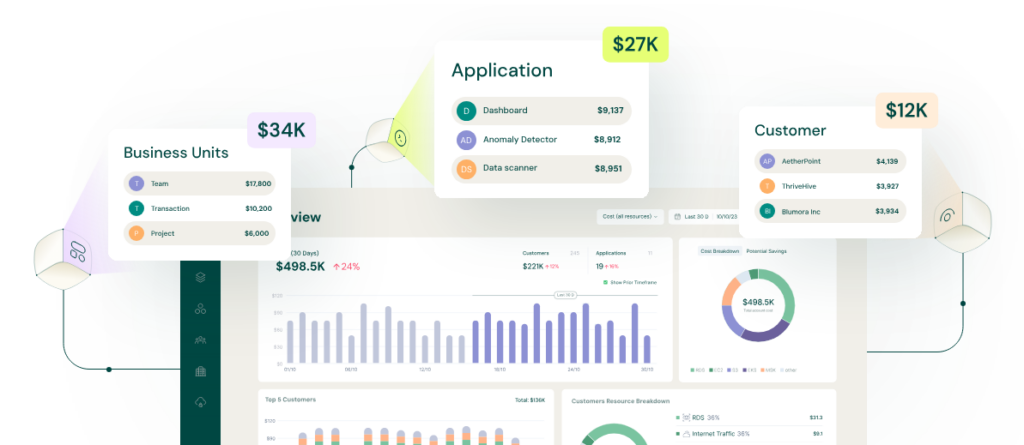
Attribute is an innovative cloud cost observability and unit economics platform that delivers FinOps without manual tagging. Unlike traditional tools that depend on resource tags for cost attribution, Attribute uses automated cost grouping, usage telemetry, and runtime data analysis to map cloud spend to workloads, applications, features, and business entities — all without requiring tagging or upfront instrumentation.
At the heart of Attribute’s offering is its ability to provide true granular cost visibility at the application and query level by correlating cloud usage data with telemetry and execution context. This means teams can see exactly how much specific services, queries, or customer workloads cost — even for shared resources or multi‑tenant environments — without manual tagging or retrospective data stitching.
The platform’s tagless methodology not only simplifies adoption — often providing actionable cost insights without changes to existing tagging strategies — but also accelerates time‑to‑value for FinOps teams struggling with manual classification and incomplete cost data.
14- Zesty
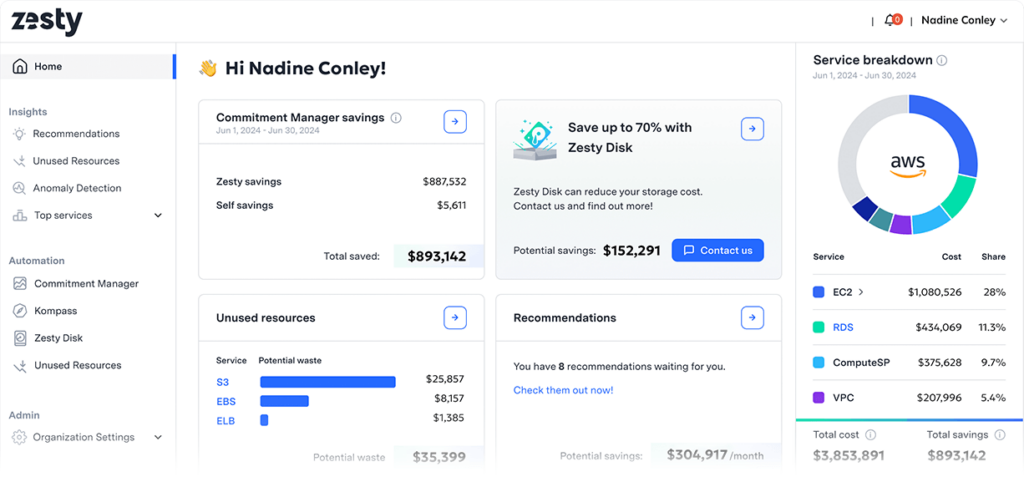
Zesty is an AI-powered FinOps platform built to automate and optimize AWS cloud costs in real time, minimizing manual intervention while maximizing savings. By leveraging machine learning and predictive analytics, Zesty dynamically adjusts cloud resources based on actual usage patterns, ensuring businesses only pay for what they need while maintaining performance and reliability.
In 2024, Zesty expanded its platform to Kubernetes environments through Kompass, extending automated cost management and resource optimization to containerized workloads. This allows organizations to manage multi-cloud and cloud-native environments efficiently, reducing costs while improving infrastructure utilization.
Pricing
- Kompass (Kubernetes Optimization): $500/month base fee + $5 per managed vCPU
- Commitment Manager (EC2 & RDS Savings): Pricing based on a percentage of the actual savings achieved
- Zesty Disk (EBS Auto-Scaling): Starts at $0.025/unit, with volume-based discounts; can reduce EBS costs by up to 70%
- Enterprise (Custom Pricing): For organizations with over $20,000 in tracked cloud spend, offering advanced features and dedicated support
15- Infracost – Cloud Cost Estimates for Infrastructure as Code
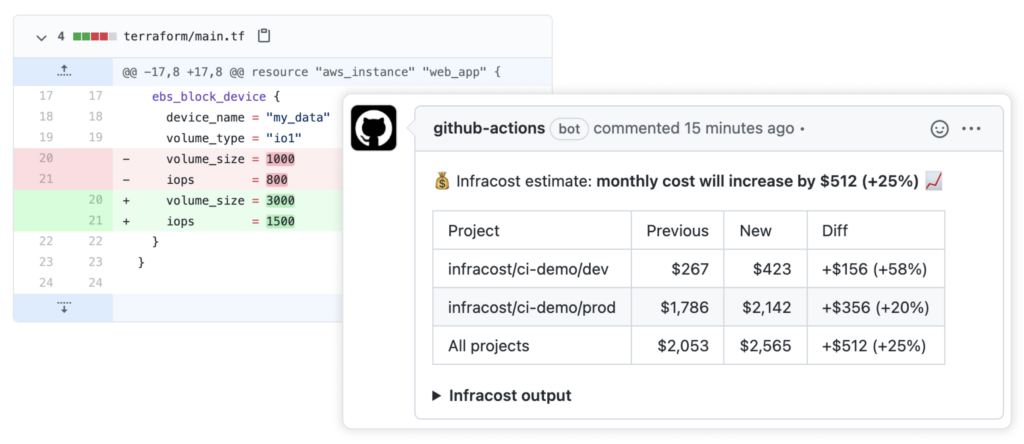
Infracost is a developer-centric FinOps tool that provides real-time cloud cost estimates for Infrastructure as Code (IaC). It integrates with Terraform, Pulumi, and OpenTofu, allowing engineers to see the cost impact of changes before deployment. By shifting cost awareness left in the development process, Infracost helps teams prevent overspending and align infrastructure decisions with budget constraints.
Key features include cost breakdowns within pull requests, automated cost policies, and integrations with CI/CD pipelines and collaboration tools like GitHub, GitLab, and Bitbucket.
Infracost supports AWS, Azure, and Google Cloud, providing detailed insights into compute, storage, networking, and other cloud services.
With its open-source foundation and enterprise offerings, Infracost is trusted by engineering and FinOps teams to optimize cloud costs at scale.
Pricing
- Free – Basic cost estimation and CLI access.
- Infracost Cloud ($1,000/month) – Best for FinOps and platform teams.
- Enterprise (Custom) – Premium support, self-hosting, and integrations for large-scale deployments.
16- Economize
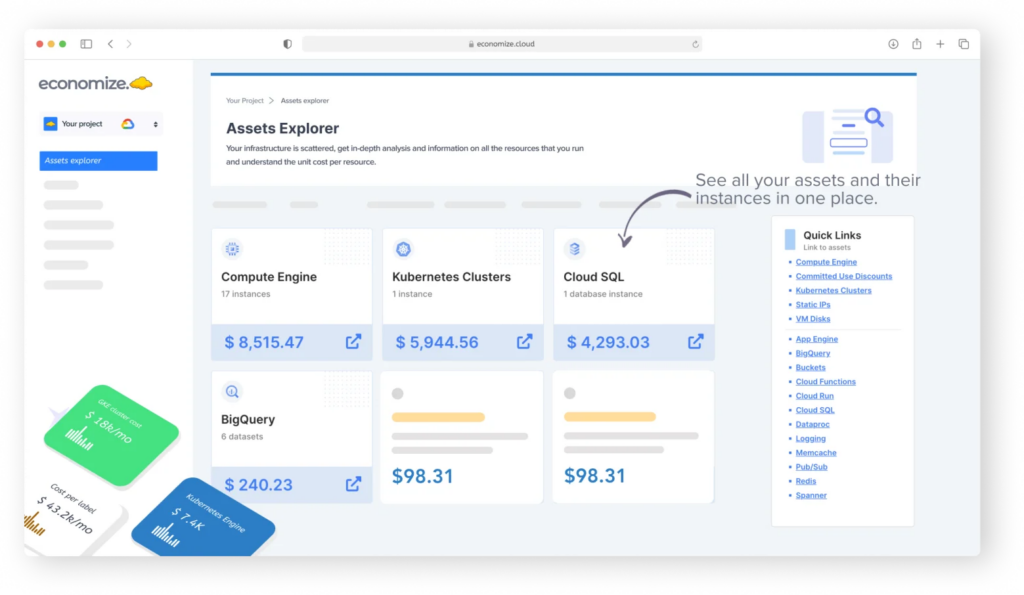
Economize is a cloud cost management and FinOps platform designed to help organizations streamline financial operations and optimize cloud spending with precision. The platform delivers advanced analytics and cost optimization capabilities, enabling teams to gain deep visibility into cloud usage and uncover inefficiencies, waste, and opportunities for savings across multiple cloud providers.
With real-time reporting, forecasting, and cross-cloud dashboards, Economize allows organizations to track costs by project, team, or environment, ensuring cloud spending aligns with strategic business objectives. Its automated recommendations leverage historical usage patterns to highlight underutilized resources, redundant services, and rightsizing opportunities, helping teams proactively reduce costs.
Economize also supports budget management and governance, allowing users to set budget thresholds and receive alerts when spending approaches limits, ensuring greater financial control and accountability.
Pricing:
- Economize offers a free pan
- The Professional : $250/month for businesses that spend up to 250K/monthly
- The Enterprise plan: $2 500/month for businesses that spend more than 250K/monthly
17- Turbo360: Azure Cost Optimization Platform:
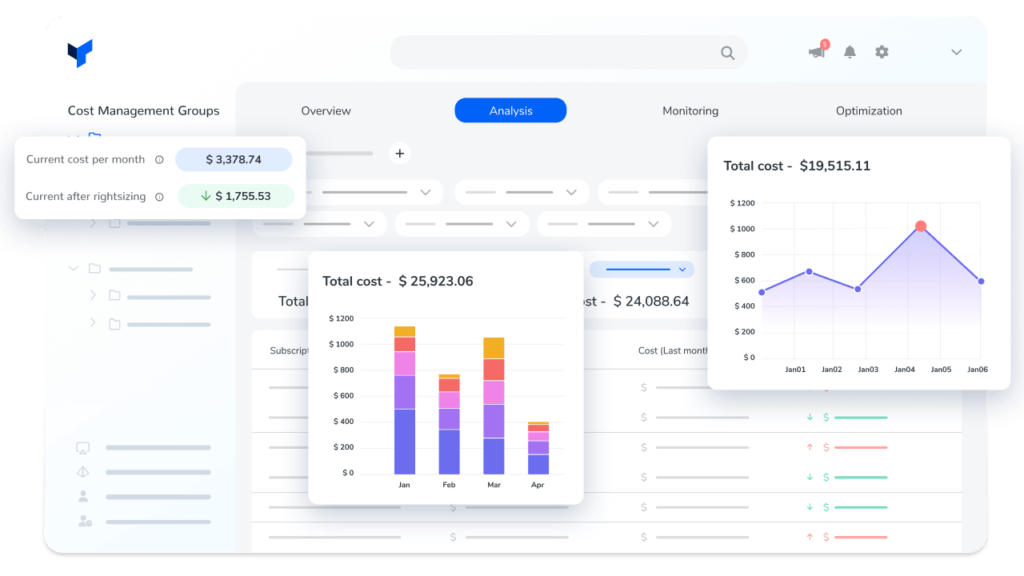
Turbo360 is an advanced cloud cost management platform built to optimize Azure cloud investments and enhance ROI. It helps businesses monitor resources, reduce costs, and generate technical documentation, all within a unified platform. By integrating with Azure, Turbo360 provides granular cost visibility, enabling organizations to attribute and track spending across departments and cost centers.
The platform delivers automated cost-saving recommendations, including opportunities for Reserved Instances and scaling down resources during inactivity, which can lead to savings of up to 70%. With a strong focus on proactive monitoring, Turbo360 helps companies quickly identify cost anomalies and address issues before they impact operations. Additionally, it offers automated technical documentation generation, saving time and improving compliance by easily creating architecture diagrams and security audits.
Turbo360’s ability to streamline Azure management, coupled with its powerful optimization features, empowers businesses to reduce their infrastructure team’s workload while maximizing cost savings.
Pricing:
Turbo360 offers a free trial for 14 days and then you need to contact their sales team to get a custom quote.
18- Maavrik (formerly Digitalex)
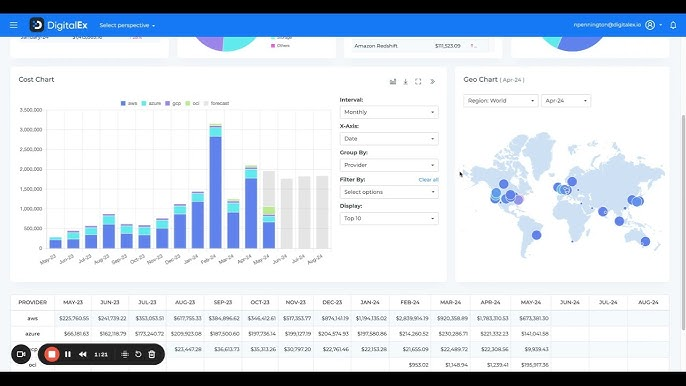
Mavvrik is the evolved FinOps and IT financial control platform that was formerly known as DigitalEx. In 2025, the company rebranded to expand its mission beyond traditional cloud cost management to provide a unified financial control center for modern IT spending, including public cloud, private infrastructure, AI workloads, SaaS, and hybrid environments.
Mavvrik delivers comprehensive cost visibility and governance across AWS, Azure, Google Cloud, on‑premises infrastructure, and SaaS applications. Its platform uses AI‑powered analytics to help CFOs, FinOps teams, and IT leaders eliminate spending blind spots, enforce cost accountability, and transform IT costs into strategic investments.
Key capabilities include real‑time cost tracking and allocation, automated chargeback and showback, predictive budget controls, and anomaly detection to prevent unexpected overruns. Mavvrik also supports detailed cost‑to‑serve analysis at the product, customer, and feature level, enabling organizations to understand unit economics and align spending with business outcomes.
The platform is designed to break down financial silos across cloud and hybrid environments, bringing visibility to multi‑cloud, on‑prem, AI, and SaaS costs from a single pane of glass. It also offers tools for managing GPU and AI model workloads, enabling precise allocation and forecasting of AI‑related spend — an increasingly critical capability as AI infrastructure costs rise.
By combining real‑time insights, automated governance, and predictive forecasting, Mavvrik helps organizations improve cost efficiency, enforce financial discipline, and reduce waste while maintaining operational agility and innovation.
19- Greenpixie
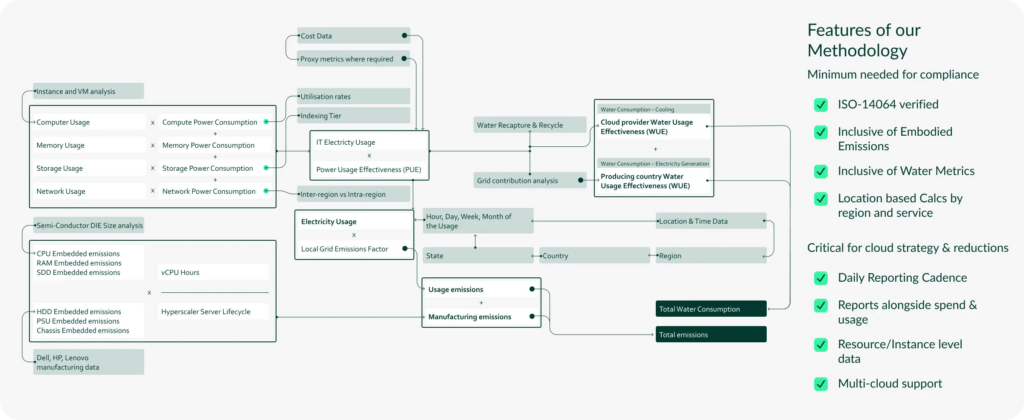
Greenpixie is a FinOps and GreenOps platform that helps organizations optimize cloud costs while measuring and reducing carbon emissions. Built for multi‑cloud environments including AWS, Azure, and Google Cloud, Greenpixie combines cost data with high‑granularity, usage‑based emissions metrics — enabling teams to manage cloud spending and environmental impact from a unified perspective.
A distinguishing strength of Greenpixie is its usage‑based carbon measurement technology. Rather than relying on spend proxies, the platform analyzes raw cloud usage data to calculate emissions — including Scope 3 carbon, energy, and water consumption — at the same granularity as financial cost metrics. This allows sustainability, engineering, and FinOps teams to see precisely where cloud resources are driving both cost and
Through integrations with major FinOps tools and cloud cost platforms, Greenpixie enables enterprises to embed sustainability data directly into existing workflows. For example, its emissions datasets are being incorporated into broader cloud cost solutions to help FinOps teams set decarbonization priorities alongside cost‑reduction strategies.
By combining financial and environmental observability, Greenpixie empowers businesses to pursue greener cloud operations while driving efficiency, accountability, and ESG‑aligned cloud governance.
20- CloudCustodian – 6K github stars

CloudCustodian is an open-source cloud governance and FinOps tool designed to help organizations manage, optimize, and control cloud costs through automated policy enforcement and resource optimization. Supporting AWS, Azure, and Google Cloud, the platform allows users to define custom rules and policies to monitor cloud usage, enforce best practices, and ensure resources are aligned with organizational goals.
The platform focuses on cost efficiency by automating actions such as shutting down idle instances, right-sizing overprovisioned resources, and deactivating underutilized services. Its visibility and reporting features give teams clear insights into cloud usage, helping them identify savings opportunities and maintain financial accountability across multiple providers.
With a flexible and extensible architecture, CloudCustodian’s rules can be tailored to specific organizational requirements, making it ideal for teams seeking customized governance, compliance, and cost control. By combining automation with cloud cost management, CloudCustodian empowers organizations to reduce waste, enhance operational efficiency, and maintain transparency in cloud spending.
Wrap up: Who is the best finops tool in 2026?
Selecting the right FinOps tool in 2026 depends on your organization’s unique cloud environment, usage patterns, and financial goals. Are you looking to optimize Kubernetes workloads, manage commitment plans, or gain comprehensive cost visibility and allocation? Which cloud providers or multi-cloud setups are you using? Your answers will shape the best choice for your needs.
For organizations with smaller cloud footprints, native cost management tools from cloud providers are often a solid starting point, and they continue to improve each year. However, as cloud environments grow more complex — particularly with AI workloads, containerized services, and multi-cloud architectures — the demand for advanced FinOps platforms that offer automation, real-time monitoring, and predictive insights will only increase.
Looking forward, automated cost optimization, anomaly detection, and real-time spend monitoring will remain essential capabilities for organizations aiming to maximize efficiency without sacrificing performance or scalability. By adopting a powerful FinOps tool, teams can take control of cloud spend, reduce waste, and align costs with business priorities — all while maintaining the agility required in modern cloud environments.
Try Holori for free now: https://app.holori.com/